



Author: Cooper Duschang
Compiled by: Shenchao TechFlow
Shenchao Introduction: The biggest difference between this altcoin market cycle and the past is that capital is no longer blindly chasing Memes, but instead flowing toward protocols that can actually make money. Privacy coins are making a comeback due to their utility, while lending and DEX leaders are using revenue to buy back tokens. The implication for investors is direct: stop looking only at narratives and look at protocol ledgers.
Key Takeaways
- As investors continue to focus on the utility of tokens and protocols, Meme coin launchpads and privacy coins have attracted more interest. In the MSCI classification, the year-to-date median return for Meme coins is -27%.
- Investors are shifting toward revenue-generating protocols, such as Aave, which is expected to generate $47 million in revenue from the Ethereum lending protocol. Monetizing services is becoming an increasingly important metric for measuring protocol growth.
- Protocols such as Hyperliquid and Uniswap are using revenue to buy back and reduce circulating token supply. Since announcing its buyback plan, Uniswap has burned more than $12 million worth of UNI tokens.
Introduction
BTC accounts for about 56% of total crypto market capitalization. Historically, the crypto market has been dominated by monitoring Bitcoin's returns and its reaction to macroeconomic conditions. While Bitcoin may account for a large portion of the crypto market, it does not represent the entire industry.
In previous bull markets, capital usually flowed first into blue chips and large crypto assets (BTC, ETH, SOL), and then into alternative coins or altcoins. That is no longer the case today. Now, altcoins sometimes receive as much or even more attention than large crypto assets. The various crypto sectors and sub-sectors that make up altcoins provide investors with ample opportunities to earn excess returns.
In the recent market rebound, investor interest in altcoins during periods of rising optimism has become more concentrated in a few sectors and protocols. In this issue of the Network State report, we will explore some of the trends driving the performance of privacy coins and Meme coins, the shift from Meme coins to revenue-generating protocols, and highlight protocols that use revenue for token buybacks to return value to token holders.
Privacy Coins
The pseudonymous nature of blockchains allows users to identify spending patterns, counterparties, and other information, limiting the number of sensitive activities that can be executed on-chain. One of the leading privacy-preserving solutions is the Zcash network. Zcash forked from the Bitcoin codebase in 2016 and introduced optional private transactions and address features. Year to date, Zcash has achieved a 218% return.
Source: Talos CM Market Data Pro
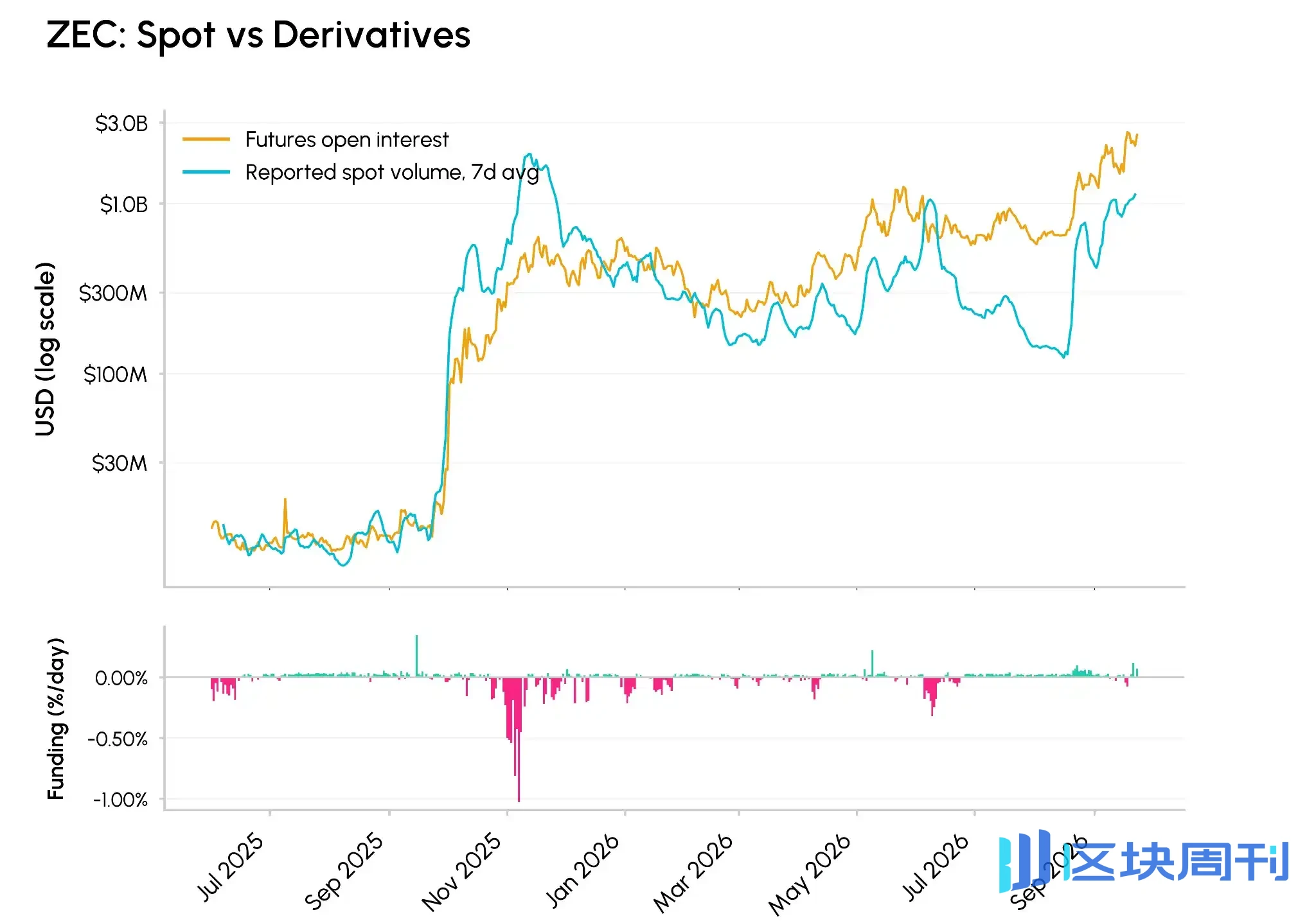
ZEC futures exploded in October 2025, with open interest surpassing $300 million before 2026. After funding rates turned negative and triggered a reversal, open interest continued to climb and has now exceeded $2 billion.

Source: Talos CM Network Data Pro
Zcash supports two key features for enhancing privacy: shielded pools and shielded transactions. Shielded pools provide customized cryptographic security and privacy properties. Shielded transactions use zero-knowledge proofs to keep transaction details such as participants and amounts hidden.
In 2026, the shielded ZEC supply reached a new high, with slightly more than 30% of the ZEC supply held in shielded or private addresses. Shielded transactions accounted for 52% of total Zcash transaction volume, showing user adoption of privacy-preserving technology. Against the backdrop of returning interest in the crypto market, usage surged in August 2026.
Meme Coins
Meme coins have historically helped networks bootstrap liquidity and attract capital. Ecosystem-specific launchpads are gaining momentum. Users are mainly migrating to Pump.fun on Solana and Pons on the Robinhood chain; the PUMP token is up 134% year to date.

Source: Talos CM Prices
Not all Meme coins are created equal: among Meme coins, very few tokens have achieved positive returns year to date. In the MSCI Datonomy sub-sector, the median loss for Meme coins is 27%.
Successful Meme coins are adopting new distribution methods. Some Meme coins have created pools that pair the corresponding token with tokenized stocks. This practice has become popular on the Robinhood chain, where the pool attempts to drive up the price of both the Meme coin and the tokenized stock by manipulating the circulating supply of the tokenized stock.

Source: Talos CM Network Data Pro
Example: A developer creates a "MEME/AMC tokenized stock (AMC)" Uniswap pool. Users buy AMC and swap it in the pool to buy MEME. The more AMC in the pool, the more the MEME token price rises because the amount available for swapping decreases. When investors rush to acquire MEME, this pushes up the price of the AMC tokenized stock because the AMC supply is limited. To meet the demand for AMC, authorized market makers must buy AMC shares on traditional exchanges, tokenize them, and sell them to buyers. This buying pressure is intended to push up the AMC stock price by decoupling the price of the tokenized variant from the underlying stock.
Revenue-Generating Protocols
On the other end of the spectrum, investors are also allocating to protocols that have successfully monetized their services, such as meme coin launch platforms.
Uniswap's UNIfication proposal enables the Uniswap protocol to capture a portion of the trading volume fees from v2 and v3 pools. With the fee switch mechanism enabled, Uniswap can fund additional projects, incentives, and initiatives that promote protocol growth. In August 2026, on Ethereum, v3 pools accounted for approximately 47% of Uniswap's trading volume.

Source: Talos CM Market Data Pro
Lending protocols have also achieved sustainable room for growth. Each Aave lending market has a reserve factor that takes a certain percentage of the interest fees earned from borrowers directly into the Aave treasury. Because of price stability and deep liquidity, stablecoin lending is very popular. On Ethereum, five stablecoins on Aave account for approximately 68% of total fee revenue. On an annualized basis, Aave is expected to generate approximately $47 million in revenue from Ethereum lending protocols.

Source: Talos CM Network Data Pro
Token Buybacks and Burns
A popular use of protocol revenue is to buy back tokens from the open market and burn them or remove them from supply. A growing number of protocols are announcing token buybacks to return value to token holders.

Source: Talos CM Market Data Pro
Hyperliquid continuously uses revenue to buy back and burn HYPE tokens. The services and products that generate revenue for Hyperliquid include:
Trading volume: Trading volume on HyperCore markets, HIP-3 HyperEVM markets, and HIP-4 outcome markets generates trading fees, a portion of which is managed by Hyperliquid.
HIP-1 and HIP-3 auctions: HIP-1 and HIP-3 builders bid HYPE to win auctions. After winning an auction, the HIP-1 or HIP-3 builder can deploy spot or perpetual markets on HyperEVM, respectively. The HYPE tokens bid by the winning bidder are burned.
USDC as AQAv2: USDC is an Aligned Quote Asset v2 (AQAv2). For every $1 of yield earned on USDC-supported Treasuries and short-term assets on Hyperliquid, Circle and Coinbase must share approximately 90% of the reserve yield with Hyperliquid.
HyperEVM fees: Fees for interacting with the HyperEVM network can be collected by Hyperliquid validators participating in network security.
Other revenue-generating protocols, including Uniswap and Aave, are also buying back and burning tokens. On Ethereum, Uniswap has burned more than $12 million worth of UNI. The latest guidance issued by the SEC supports properly functioning protocols buying back tokens without being deemed securities.

Source: Talos CM Network Data Pro
Outlook
The recent altcoin rally has been more concentrated than in the past and is considered to be of higher quality. Meme coins still account for part of the rally, but we are seeing capital rotate into protocol tokens with exposure to dominant themes, whose protocols' services generate revenue and improve the protocol through reinvestment or token buybacks.