Editor|Panda
A computational record in theoretical physics that had stood for three years has been broken by AI.
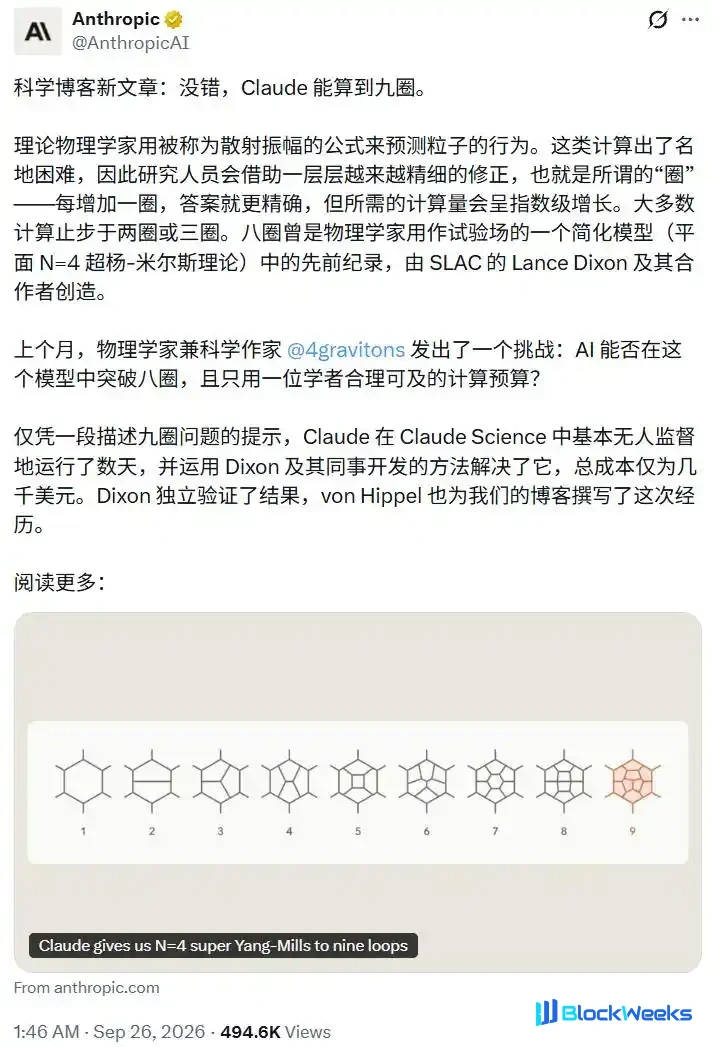
A few hours ago, Anthropic announced: Claude, on the research platform Claude Science, ran continuously for several days essentially unsupervised and computed the nine-loop six-particle scattering amplitude in planar N=4 super-Yang-Mills theory.
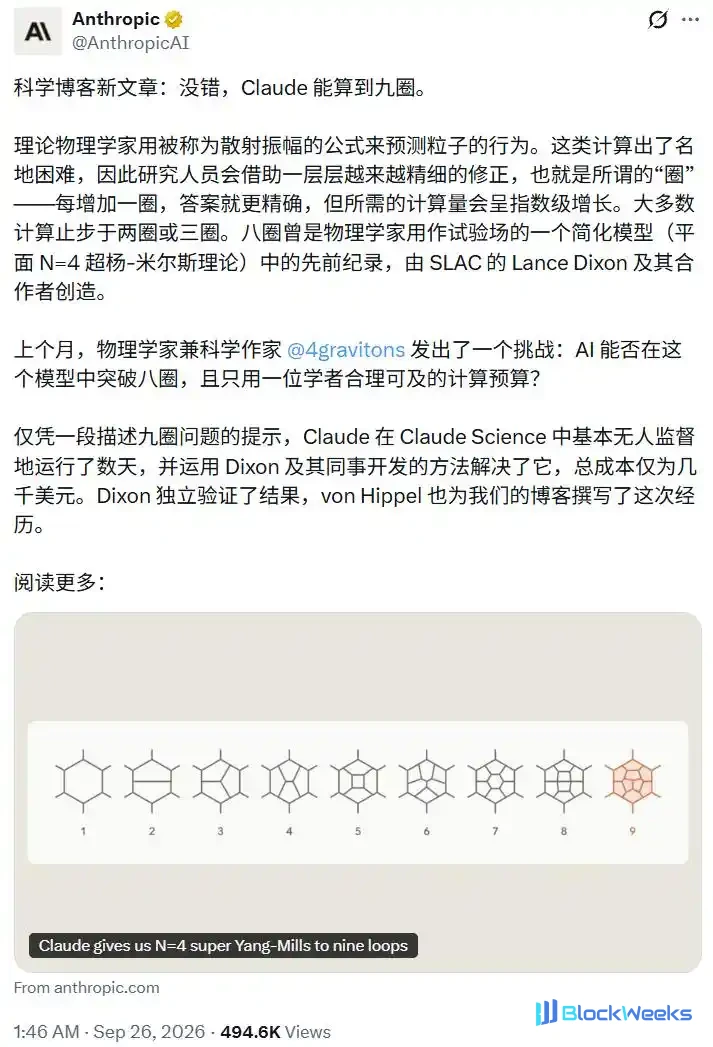
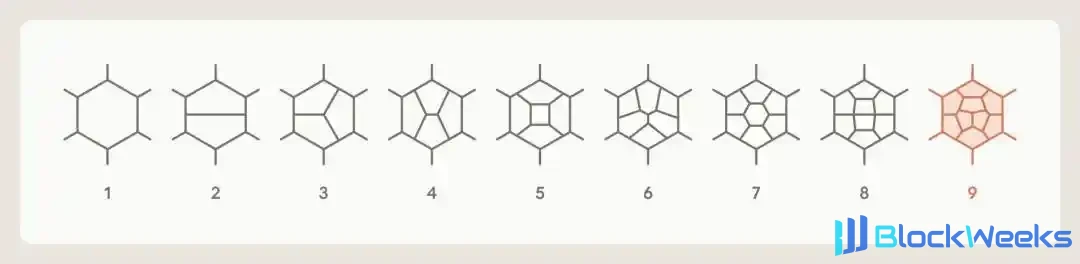
This is a recognized frontier problem in the field of theoretical physics known as "scattering amplitudes." Previously, the highest record in this model stood at eight loops, set in 2023 by Lance Dixon of SLAC National Accelerator Laboratory and collaborators.
This breakthrough was personally vetted by the creator of the eight-loop record. Dixon independently verified Claude's result and commented that a large language model being able to execute every step of this complex recipe and organize the computation was, in his view, "a rather remarkable victory." He even said outright that, apart from his collaborators, Claude understands their team's two papers from 2019 and 2023 better than anyone else.
Even more surprising is the process and cost. The researchers gave Claude only a one-sentence task description, and after that the "guidance" was almost nothing more than "continue"; the entire computation, converted to an ordinary user's costs, was about one to two thousand dollars, of which the part actually used for numerical computation was only about $100, equivalent to 96 CPUs running for a week. Yet Dixon had originally thought that directly computing the nine-loop amplitude was too difficult, and his team had been preparing for it for several years.
The starting point of this breakthrough was a public "challenge."
On August 7, former theoretical physicist and science communicator Matt von Hippel published a somewhat provocative article on his blog 4gravitons, titled "Only AI Entering My Field Counts." In it, he explicitly issued a challenge to AI companies: use computing power that a scholar can afford to solve an unresolved major problem in the field of scattering amplitudes.
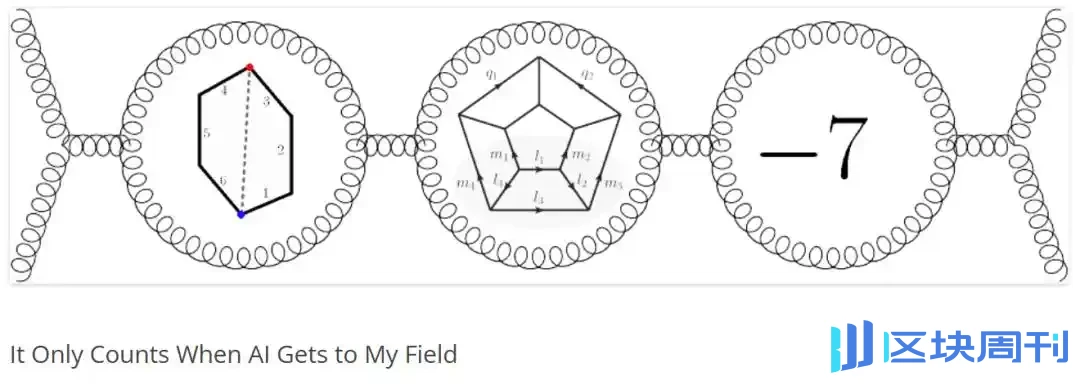
He gave two options: either compute N=8 supergravity to seven loops, or compute the six-particle amplitude in N=4 super-Yang-Mills theory to nine loops.
A month later, AI completed the adjustment. What Anthropic has just published is precisely a guest article written by von Hippel himself, titled: "Yes, Claude Can Do Nine Loops."
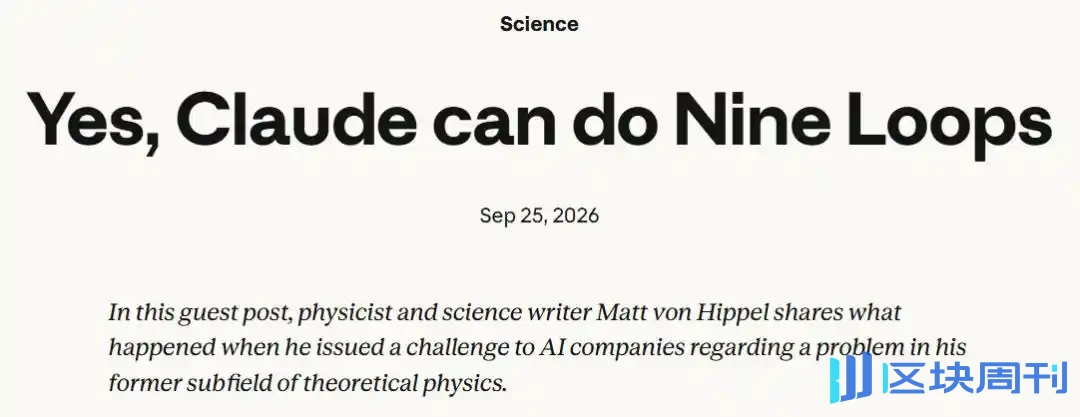
https://www.anthropic.com/research/yes-claude-can-do-nine-loops
Nine loops, where is the difficulty?
To understand the weight of this matter, one must first clarify what physicists are calculating.
Particle physicists predict particle behavior using a class of formulas called "scattering amplitudes": given the energy and momentum of the particles involved in a collision, the scattering amplitude can tell you the probability that they will react in a certain way.
The more precise the prediction, the more detailed the comparison can be with results from experiments such as the Large Hadron Collider (LHC). Once a deviation appears, it could be a clue to new physics, such as the nature of dark matter, or why matter and antimatter in the universe are asymmetric.
The problem is that scattering amplitudes are extremely difficult to calculate precisely, and physicists can almost only make approximations. They layer the calculations by "loops"; the number of loops roughly measures how complex the interactions between particles are allowed to be. Each additional loop brings the answer closer to the true value, but the amount of computation also expands dramatically. In the original challenge text, von Hippel wrote that the complexity of such calculations usually grows exponentially or even factorially with the number of loops.
So in reality, the vast majority of scattering amplitudes are only computed to two loops, and a few can reach three loops. The most precise prediction in particle physics, the electron anomalous magnetic moment, used five loops.
N=4 super-Yang-Mills theory is a special toy model in this field. "Yang-Mills" is the theoretical framework describing the three fundamental interactions: electromagnetism, the strong nuclear force, and the weak nuclear force; "N=4 supersymmetry" means each particle is paired with four supersymmetric partners. There are so many particles that it is unrealistic; this theory does not describe the real world. But it is precisely this high degree of symmetry that causes many combinations of variables to cancel each other out, making the calculations relatively manageable. Researchers hone new methods here to see how far they can go.
The method used this time is called "bootstrap." von Hippel compared it to Sudoku: first write out all possible forms of the answer, record them in computer files using a special "alphabet," then use all known constraints to eliminate them one by one, including predictions from other methods, rules the answer must obey, and known results from related problems. Ideally, in the end only one candidate passes all checks, and there are extra checks left over to confirm no mistakes were made.
The eight-loop record was obtained by Dixon taking a detour. In 2023, he and Yu-Ting Liu used a peculiar symmetry called "antipodal duality" to first compute the relatively easier "form factor," and then convert it to the eight-loop amplitude. For several years afterward, his team kept their eyes on nine loops, planning to follow the same indirect route. In his view, directly computing the nine-loop amplitude was too difficult.
It is worth mentioning that von Hippel himself is a veteran of this research line. He had previously collaborated with Dixon and others to push the six-particle amplitude to six loops and seven loops. In other words, he picked a bone that he had gnawed on himself.
One prompt, then keep saying "continue"
At the end of August, two physicists at Anthropic, Liam Fitzpatrick and Siddharth Mishra-Sharma, contacted von Hippel and told him that the challenge had been conquered.
They used the Fable 5.1 model, running on the Claude Science platform. In the article, von Hippel explained that Claude Science is a kind of "harness," that is, wrapping structured rules and prompts around a large model to make it perform more robustly on scientific research tasks.
According to the article, the two first asked Claude which challenge it was most confident about, and then gave only a very brief task description: compute the nine-loop six-particle (hexagon) amplitude in planar N=4 SYM.
After that, the "research guidance" was basically just letting it keep going. A typical instruction disclosed in the article went roughly like this: I am going to sleep, I will be away for the next few hours, keep working until I tell you to stop, and report progress every four to six hours.
In the end, Claude calculated it once in each of two ways: first, the direct bootstrap method, and second, the indirect route via form factors used by Dixon's team. According to the article, either one cost the end user roughly one to two thousand dollars, with the bulk being the cost of running the model itself for a long time. The bootstrap calculation part was done with Python and the symbolic computation library SymPy, accounting for only about 100 dollars, equivalent to 96 CPUs running for a week.
von Hippel lamented that when he did this kind of research ten years ago, 96 CPUs running for a week was a considerable investment, whereas now, as long as there is sufficient reason, this amount of resources is quite affordable.
The verifier's feeling: like a collapsed soufflé
At the end of the article is a postscript written by Dixon himself, titled "What it feels like to be scooped by a machine."

He wrote that on September 1, the two Anthropic researchers told him that Claude had calculated the nine-loop amplitude and asked him to verify the result. For him, that moment was when the idea of large language models changing physics "truly landed on him."
What impressed Dixon was not so much the scale of the computation as the fragility of the entire process. According to his description, if any one part of this calculation recipe went wrong, the whole result would collapse like a failed soufflé, and the researcher would have to go back and painstakingly troubleshoot. Moreover, many of the construction details were so tedious that they would not be written fully into a paper, which meant that Claude had to build all the code from scratch.
Since it is relatively easy to infer the nine-loop form factor from the nine-loop amplitude, Dixon mainly carried out the verification along this route. This also led to a slightly delicate situation: what he spent two weeks verifying was precisely the goal his own team had been pursuing for several years.
He admitted that he did not feel frustrated, for two reasons.
His team had already been using custom Transformer models to predict results at higher loop orders, and had even put forward a slogan to the effect that as long as the machine gives a candidate answer, they have a full set of tools to verify it.
When solving the problem, Claude used exactly the methods that Dixon and his collaborators had developed over many years, and even the presentation format of the results followed their existing conventions. In his view, while he was verifying Claude, Claude was also verifying all their past work. This is also the origin of his remark that "Claude understands our papers better than anyone else."
But amid the praise, Dixon also said that, in his view, the moment that will truly keep people tossing and turning will come when a model proposes new physical principles and insights before humans do.
A Chinese team arrived almost simultaneously
There is also a parallel thread to this story, and it is related to China.
Just a few days after Anthropic contacted von Hippel, Song He of the Institute of Theoretical Physics, Chinese Academy of Sciences, also got in touch: his research group had already obtained most of the nine-loop result. On September 17, Song He, Jirong Jing, and Xiang Li publicly released a dataset on Zenodo titled "The symbol of six-gluon MHV amplitudes up to nine loops," covering symbol data from two loops to nine loops.

https://zenodo.org/records/22800071
According to the descriptions of von Hippel and Dixon, Song He's team also used AI assistance based on GPT-6, but only for computing some of the constraints, while the overall framework was still built by humans. This is completely different from Anthropic's nearly fully automated route of "one prompt plus repeated continue."
In the postscript, Dixon mocked himself: within two weeks he had been scooped first by "a machine" and then by "humans plus machines."
von Hippel specifically mentioned that the atmosphere among the parties was quite friendly. Next, Dixon, Song He, and their collaborators will publish these results and provide detailed explanations and analysis for later researchers.
The challenger's retrospective: there are more low-hanging fruits than imagined
Back to von Hippel himself. When he originally set the challenge, he wanted to use a field he was familiar with to answer this question: can AI actually bypass those computing bottlenecks that everyone assumes are insurmountable?
The logic in his original challenge text was as follows: everyone outside is debating whether AI can produce genuinely new ideas, but how hard ideas are to find is only known after they are found; the difficulty of computation is more "concrete." Many doomsday scenarios about superintelligence, from simulating human minds to manipulate people's hearts to designing nanomachines from first principles, are met by critics with the standard rebuttal that there is not enough computing power. If AI can use academic-level resources to solve a problem generally recognized as computation-limited, that would truly be cause for worry.
And the result? von Hippel's conclusion is very candid: this time there did not appear the kind of "breaking through the computing barrier in an unexpected way" that he had hoped for.
Claude used known methods, only with somewhat more computing power than humans had previously been willing to invest. It may have benefited from using Python rather than Maple or Mathematica, which physicists are accustomed to, and its software engineering practices may also have been more standardized than those of human researchers, but it did not reach the level of "superintelligence." The fact that Song He's team arrived almost simultaneously also shows from another angle that this goal is not beyond human reach.
His biggest takeaway from this is: even if the goal is simple and clear, things that seem out of reach in the eyes of experts may actually not be that hard, and there are more low-hanging fruits than expected. For years, friends with computer backgrounds had told him that amplitude researchers could make great progress simply by hiring a few more programmers, and von Hippel admitted that these people can now feel they were right.
But he also emphasized the other side. This kind of computation is tedious and messy, and if he himself had used 96 CPUs to run for a week, he would almost certainly have had it drag on to two weeks because of a first mistake. Claude Science, however, ran through it in one go with almost no scientific supervision, without relying on input from any external collaborators. His advice to those who still think AI is full of errors and not up to the task is: this kind of work, it can now reliably complete.
He also made a longitudinal comparison. In March of this year, in Anthropic's "vibe physics" experiment, AI doing physics projects was still like a student, with small task scales, requiring a lot of hand-holding, and frequent errors. Half a year later, what it completed was already frontier computation that only top experts in the amplitude field would touch. He did not rule out that this happened to be a problem especially suited to AI, but he judged that the technology itself had indeed become stronger.
As for whether it can be generalized, von Hippel remains cautious. Toy models like N=4 usually belong to a very small research circle, while amplitude calculations for the real world are far more competitive, where the low-hanging fruit may be even scarcer. But he also reminds researchers doing these calculations that if they haven't yet tried having an AI research platform take a one-shot crack at frontier calculations, they should give it a try, and at the same time be prepared with a plan to verify the results. He wouldn't be too surprised if someone could squeeze out one more loop within a reasonable budget.
Final Thoughts
Putting this matter back into the context of September makes it even more interesting.
On the 8th of this month, OpenAI announced that its undisclosed model mobilized tens of thousands of AI agents and produced a counterexample to the existence and smoothness problem of the Navier-Stokes equations, which is one of the Millennium Prize Problems; the result is still under review by the mathematics community. Compared with that kind of "large-scale army operation" using massive computing power, the story of the nine-loop amplitude seems much more modest: a commercial research platform, a single task description, a few thousand dollars, and a few days.
And precisely because it is modest, it may deserve more attention from academia. von Hippel ultimately admitted that he had originally hoped to use this challenge to glimpse the future, to see some unprecedented new method of computation, and thereby gain an evidence-based judgment in the debate about superintelligence. But the answer he got was that his previous understanding of where the limits lay had been too naive.
And the question Dixon left behind still hangs in the air: when large models are no longer merely executing recipes written by humans, but begin to propose new physical principles before humans do, how should physicists position themselves?
© THE END
This article comes from the WeChat public account "Machine Heart" (ID: almosthuman2014), author: Machine Heart