
Written by: Liu Honglin
If a few years ago someone said that in the future you could buy shares of Apple, Tesla, and Nvidia on the blockchain, most people's first reaction might be: isn't this just turning stocks into a token? Even many people in the crypto industry would further imagine: since it becomes a token, does that mean that in the future there will be no need for brokers, no need for exchanges, no need for clearing institutions, and with a wallet, you can trade US stocks freely around the world 24/7 just like trading USDT?
This imagination is half becoming reality, while the other half may be completely wrong.
In 2026, something very noteworthy is happening in the US capital market. On March 18, the US Securities and Exchange Commission (SEC) officially approved Nasdaq's amendment to its trading rules, allowing eligible securities to be traded on Nasdaq in tokenized form.
By September 17, the SEC further introduced an "innovation exemption," allowing eligible tokenized securities trading venues, under certain conditions, to use blockchain, automated market makers, and liquidity pools to trade tokenized US stocks.
If these two things are viewed together, their significance actually goes far beyond "the US allowing stock tokenization." What the US is truly beginning to attempt now is a bigger proposition: can Wall Street be put on the blockchain.
Of course, "putting" it here does not mean shutting down the New York Stock Exchange, nor eliminating the SEC, nor that in the future everyone can anonymously open a wallet and speculate in US stocks. On the contrary, what the US is attempting may be more complex and more realistic: retaining the securities laws, listed companies, shareholder rights, and regulatory system that have operated for more than a hundred years, while gradually migrating part of the underlying technology supporting this system from traditional databases to the blockchain.
If this experiment ultimately succeeds, then what blockchain truly changes may not be "what stocks look like," but the entire back office of the capital market.
What exactly does putting stocks on the chain mean?
Today many people talk about RWA, that is, the tokenization of real-world assets, and the easiest thing to confuse is: is the token actually that share of stock?
This question is very important, because on the surface everyone calls them "tokenized stocks," but in reality the legal relationships behind them can be completely different.
On January 28, 2026, the SEC's Division of Corporation Finance, Division of Investment Management, and Division of Trading and Markets issued a staff statement dividing securities tokenization roughly into two categories: tokenization by the issuer or an institution acting on behalf of the issuer, and tokenization by a third party unrelated to the issuer. This is staff interpretation of different structures, not a pass issued for all stock tokens.
These two things look very similar, but their legal meanings are completely different.
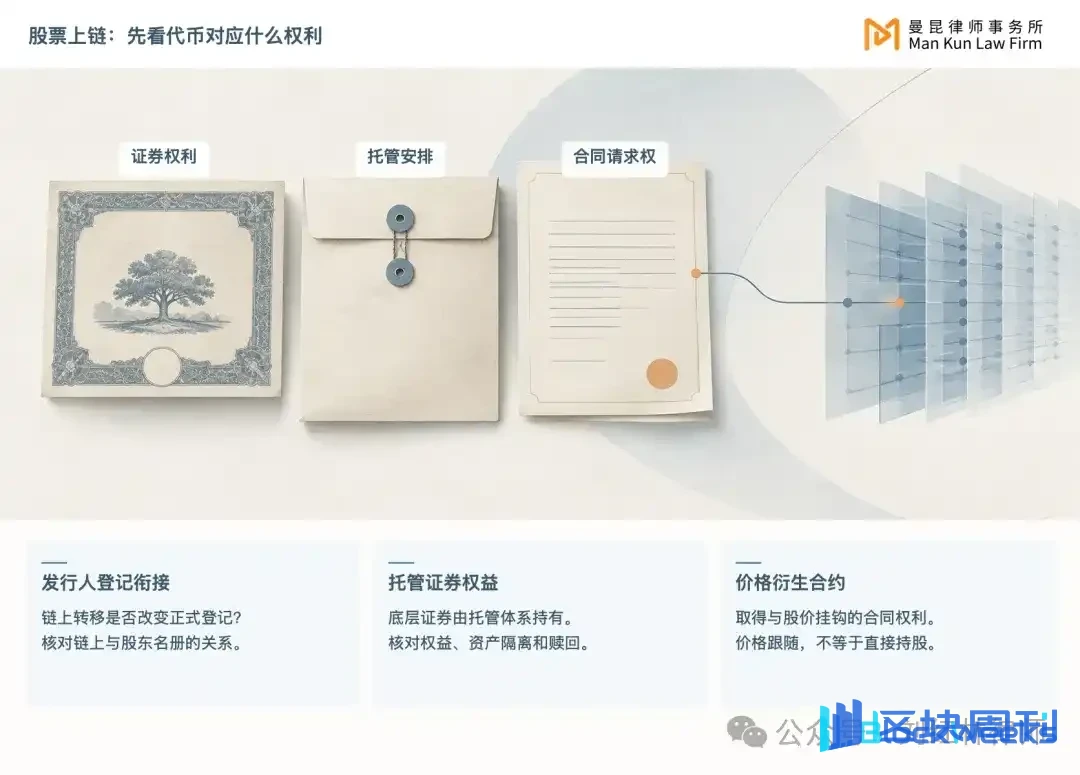
Take Apple stock as an example. If the issuer or its agent connects the blockchain to the formal securities holder registration system, then the transfer of tokens can correspond to the transfer of securities rights. But issuer participation does not mean that final registration must necessarily occur on-chain: another approach is to use on-chain transfers to notify the issuer, and then update the off-chain shareholder register. To determine what investors actually hold, one must look at how the token connects with the legal registration records.
The second model is much more complex. A platform can first buy one share of Apple stock and place it with a custodian, then separately issue an Apple stock token to you; it can go even further, and the platform does not give you ownership of that share at all, but merely signs a derivative contract with you, agreeing that if Apple rises 10%, your token also rises 10%.
These three things may all appear on a phone screen as "AAPL," but legally they are completely different assets: one may be a real stock, one may be a securities entitlement backed by stock, and another may merely be a contract tracking Apple's stock price.

This is precisely the most important starting point for understanding today's change. In the future, when we see any so-called "stock token," the first question should not be which chain it is on, but rather: what exactly are the legal rights behind this token?
The Nasdaq rules approved by the SEC in March revolve around the tokenization pilot of the US Depository Trust Company (DTC). Eligible securities can be traded in traditional form or tokenized form; the two forms must be interchangeable, use the same ticker symbol and securities identification code, confer the same rights, and enter the same order book, following the same matching priority. The specific applicable securities, participants, and settlement methods remain subject to pilot conditions.
Suppose you buy one share of Nvidia stock that meets the pilot conditions and choose tokenized settlement; it is not buying another kind of "NVDA coin." The rules seek to preserve the economic identity of the same security, allowing investors to choose different forms of holding and recording. It also does not mean that all products tracking NVDA on-chain are automatically equivalent to this share of stock.
Nasdaq even explicitly requires that tokenized securities must be fungible with traditional forms of securities and confer the same rights and privileges on investors. So if one must use a simple analogy, Nasdaq is not reinventing stocks, but attempting to change the database for stocks.
In the past, stock registration was in layer upon layer of ledgers at brokers, custodians, and clearing systems. Now the US is beginning to study: can part of these ledgers be moved onto the blockchain?
This is also why I think that simply understanding this as "RWA is hot again" actually underestimates its importance.
What is the difference between this and Binance, Robinhood, and Ondo?
From the perspective of ordinary users, it is easy to have a question: Nasdaq, Binance, Robinhood, and Ondo are all talking about stock tokenization, so what exactly is the difference between them? Here we must first distinguish roles: what Nasdaq discusses is the trading venue and market rules; for specific products, one must continue to look at who issues, who custodies, who provides the trading entry point, and what rights investors ultimately obtain.
The answer is actually still the same sentence as before: do not look at the name of the token, look at the legal structure behind the token.
First look at Robinhood's Classic Stock Tokens in its European business. According to its official product description, these products are derivative contracts between the user and Robinhood that track the price of a stock or exchange-traded product, do not directly grant underlying stock rights, and therefore do not bring shareholder voting rights. What is discussed here is this specific product, and one cannot generalize about products under the same brand in other jurisdictions or with other structures.
So, buying one of these Robinhood stock tokens is legally not the same as truly buying one share of Apple stock in a US brokerage account.
Next look at bStocks, for which Binance provides the trading entry point. Its issuer is BTech Holdings Limited, an affiliate of the Binance group. According to official disclosure, each unit of the product is 1:1 supported by underlying securities held by a regulated custodian, but bStocks itself is not stock of the underlying listed company, nor does it make holders directly shareholders of that company. Whether it can be redeemed for stock, and how dividends and corporate actions are handled, must continue to be examined in the issuance documents and platform rules; asset backing and direct shareholding are still two different things.
The US case announced by Ondo and Broadridge in July involves custodied tokenized securities for Micron stock and BlackRock's IVV ETF, as well as governance functions such as shareholder communications and voting. This shows that structures involving third parties may also connect to traditional securities rights, but one cannot infer from this that all third-party stock tokens confer the same rights.
Therefore, when comparing these products, one cannot just look at whether AAPL is written on the screen. Price exposure, custodied securities rights, and the tokenized record form of the same security differ in the claims, transfer conditions, and risk bearing behind them. The brand of the trading entry point also cannot replace verification of the issuer and custody arrangements.
For investors, the most practical question is: if the platform or issuer goes bankrupt, to whom can you assert what rights? Is it to demand delivery of the underlying securities, return of segregated custody assets, or can you only file a claim based on contract? The answer depends on the specific legal documents, asset segregation, and applicable law. For institutions building products and Web3 lawyers, these arrangements must be clearly explained before launch, and cannot be left to be explained after something goes wrong.
From trading to settlement, how is Wall Street's back office moved?
When we usually look at the stock market, what we see most easily is the trading interface: how much is Apple, how much is Nvidia, click buy, and then the trade is executed. So we easily think that the most core thing in a stock trading system is "matching."
But in reality, after a securities transaction is executed, the truly complex things have just begun.
Who is the buyer, who is the seller? Has the money arrived? Have the stocks been delivered? Where is the final ownership registered? How do brokers reconcile with each other? How does the central clearing institution handle it? How does the custodian keep accounts? How are dividends paid? How is voting rights confirmed? How are stock splits, mergers and acquisitions, and delistings handled afterward?
These things together form the enormous post-trade infrastructure of the modern securities market.
So what the U.S. capital market is truly interested in is not merely "matching a stock trade on-chain," but rather: if the security itself becomes a programmable on-chain asset, can trading, clearing, settlement, registration, and corporate actions begin to converge?
When SEC Commissioner Mark Uyeda spoke about securities tokenization this year, what he mentioned was precisely these links: issuance, trading, transfer, settlement, and ownership records. What is truly worth paying attention to is whether these actions, which in the past were completed by different institutions, different databases, and at different points in time, could in the future be completed within a single shared ledger or even a single on-chain transaction.
Today, when you click "Buy" once on an exchange, behind it is actually a long chain of collaboration among financial institutions and databases. In theory, in the future, a single on-chain asset transfer could itself simultaneously serve as the trade record, the settlement record, and the record of ownership change, and could even further trigger custody and corporate actions.
With corresponding cash settlement tools, legal effect, and risk control arrangements in place, on-chain systems have the opportunity to connect securities delivery and payment more tightly. But trading, clearing, settlement, and ownership registration are still different links, and they will not all be completed automatically just because of a single on-chain transfer.
This may be the efficiency revolution that blockchain can truly bring to the capital market.
Beyond the back office, new choices are beginning to appear even for how the front office executes trades. On September 17, the SEC launched an "innovation exemption," opening a temporary, conditional path for specific on-chain trading venues.
This arrangement allows qualifying tokenized securities trading venues to use permissioned automated market makers and liquidity pools to trade specific tokenized U.S. stocks. An automated market maker is a trading mechanism that quotes prices according to programmed rules; a liquidity pool centrally holds the assets used for trading. However, the exemption sets limits on the number of securities and trading volume, requires verification of holder rights; when the underlying stock is halted on its primary listing exchange, the related on-chain trading must also stop simultaneously.

What it relaxes are some regulatory requirements for trading venues once conditions are met, not the elimination of securities regulation. The relevant exemption has a time limit, and the market is still exploring which rules need to be adjusted.
In the past, we were used to dividing the financial world into two parts: on one side, Nasdaq, the New York Stock Exchange, brokerages, central clearing, and order books; on the other side, Uniswap, automated market makers, liquidity pools, wallets, and blockchains. Everyone has always felt that these two worldviews are completely different.
But now the SEC is beginning to allow a combination that was previously hard to imagine: stocks remain securities, but the trading mechanism can begin to draw on decentralized finance.
Stocks are still stocks, securities law is still securities law, listed companies are still listed companies, and the SEC is still the SEC. But the asset carrier can become a token, ownership registration can use blockchain, automated market makers can appear in trading venues, settlement can gradually move on-chain, investors can manage assets through wallets, and assets may further enter collateral, lending, and other on-chain financial protocols.
The regulatory framework has not been overturned, but the technical infrastructure supporting the operation of the regulatory framework is being reshaped by blockchain.
More important than 7×24 trading is that assets become "programmable"
Following this logic further, a very natural question arises: if stocks really go on-chain, can they then be traded 7×24?
Blockchain provides the technical conditions for round-the-clock transfer and trading, but whether the securities market can operate continuously also depends on whether trading rules, market-making liquidity, and the underlying securities' subscription and redemption and risk control can keep up. The absence of Saturday technically does not mean that financial institutions and the underlying market are already prepared for year-round operation without rest.
Some products have already extended trading hours. For example, Binance officially describes bStocks as a product that can be traded around the clock. But the token market being open for trading and the underlying stock market being open for trading are still two different facts.
Being able to buy and sell on weekends does not mean being able to trade at a sufficiently good price on weekends. When the underlying market is closed, market makers have fewer options for hedging and replenishing inventory, bid-ask spreads may widen, and on-chain prices may deviate from the most recent transaction price of the underlying security.
Suppose major news about Nvidia appears on Saturday. The related token market can reflect investors' judgments in advance, but this price may not equal the price after the underlying stock resumes trading. For users, what is added is trading opportunities, as well as the possibility of bearing greater price deviation when liquidity is insufficient.

Once this happens, the traditional concepts of "opening price" and "closing price" will begin to lose part of their meaning. Furthermore, the market-making system, options pricing, margin system, risk management, global liquidity distribution, and even the timing of information disclosure by listed companies may all be affected.
So 7×24 trading does not merely mean "you can also trade stocks at night." Once the capital market becomes a round-the-clock market, many institutions on Wall Street built around opening and closing will need to be rethought.
If it were merely extending trading hours from a few hours a day to 7×24, I think that would still not be enough to explain the changes that securities going on-chain could truly bring. The deeper change is that financial assets begin to have the opportunity to be directly recognized, invoked, and combined by programs.
Today you hold 100 shares of Nvidia in a traditional brokerage account. This is of course your asset. But from the perspective of the internet, these 100 shares of Nvidia still exist in a relatively closed financial system. In theory, you can of course use the stock as collateral, sell it, and participate in various financial services, but each use often requires entering the system of a specific institution. It is hard for you to directly authorize a program the way you invoke an internet service: use 30 shares as collateral to obtain liquidity, use another 20 shares for other financial strategies, and then have an AI agent manage the remaining position according to risk rules you set in advance.
The problem is not that these financial functions do not exist at all, but that completing these things today requires crossing different institutions and databases. Brokerages have brokerage accounts, banks have bank accounts, fund companies have fund company accounts, and custodians and payment institutions also have their own systems. Assets can of course move between these institutions, but each step of movement may be accompanied by identity verification, authorization, clearing, reconciliation, custody, and compliance processes. This is also why traditional finance, although already highly electronic, has not truly achieved "composability" in the internet sense.
If stocks truly become on-chain assets, the situation begins to change. Stocks can become collateral, funds can become collateral, U.S. Treasuries can also become collateral, stablecoins can assume settlement functions, and smart contracts can automatically execute financial rules according to pre-set conditions. The different capabilities originally scattered across brokerages, banks, fund companies, payment institutions, and on-chain financial protocols will have the opportunity to be built on a more unified asset and settlement network.
This is the "programmability" of assets. It does not mean that all stocks can freely enter any on-chain protocol. Securities going on-chain are still subject to investor identity, transfer conditions, and jurisdictional restrictions, and some of these explicit rules can be translated into whitelists, quotas, and freeze permissions. Code can help enforce rules, but whether the rules are legal, who has the right to modify them, and how remedies work after errors still require legal and governance arrangements.
If it really develops to this point, the change will not be as simple as "securities becoming tokens." In the past, a large number of financial rules were written in contracts and executed by banks, brokerages, custodians, and back-office personnel; in the future, some of these rules may directly become financial infrastructure automatically executed by programs. What is truly being redesigned is not only the form in which assets are represented, but also the way financial rules are executed.
Stocks going on-chain does not mean everyone can anonymously trade U.S. stocks
This is the most easily produced misunderstanding when discussing securities tokenization, and it is also something I think is particularly worth clarifying today.
Many Web3 users will naturally think: since stocks become tokens on the blockchain, can I just open a crypto wallet, connect to a decentralized exchange, and buy Apple? Even further, can a Chinese person, an American, an Iranian, and a Russian, as long as they have a wallet address, all trade freely?
At least judging from the regulatory framework currently taking shape in the United States, this is clearly not the case.
The SEC's "innovation exemption" itself emphasizes a permissioned environment. Before allowing users to trade stock tokens, Robinhood likewise requires users to provide identity information and complete corresponding investor suitability assessments and risk tests.
The reason is not complicated: "securities becoming tokens" and "securities laws disappearing" are two completely different things.
This is a sentence very much worth remembering in the entire era of securities tokenization: code can change the form of an asset, but it will not automatically change the legal attributes of the asset.
SEC Commissioner Hester Peirce had in fact already put it very bluntly: tokenized securities are still securities.
As a result, many of the original requirements still exist, including customer identity verification, anti-money laundering, sanctions list screening, investor suitability, securities issuance rules, market manipulation regulation, insider trading regulation, tax reporting, and jurisdictional restrictions, among others.
So what may truly emerge in the future is not necessarily the kind of fully permissionless decentralized finance that everyone is familiar with today. What is more likely to emerge is a permissioned form of decentralized finance: it looks very Web3, uses blockchain at the underlying layer, keeps assets in wallets, completes transactions through smart contracts, and may even use automated market makers, but wallets need to complete identity verification, the smart contracts themselves may have built-in whitelists, wallets in certain countries and regions may be unable to receive specific securities, and transfers between unverified wallets may also be impossible to complete.
This may be what the real American version of "on-chain Wall Street" looks like.

Why is this matter more important than RWA itself?
Over the past few years, when people discussed RWA, the phrase they liked to use most was "moving real-world assets onto the chain." U.S. Treasuries on-chain, funds on-chain, real estate on-chain, stocks on-chain—they all sound like the same story. But I increasingly feel that if you merely package a real-world asset into a token and then take it to a crypto exchange for trading, you have not actually transformed traditional finance.
The underlying stock may still be purchased by traditional brokerages, the assets may still be custodied by traditional custodians, and the shareholder register may still operate within the traditional securities system; the only difference is that an outermost layer of a token that can circulate on the blockchain has been added. In this sense, it is more about adding a layer of crypto asset shell around traditional financial assets.
Of course, this is not to say that such RWA has no value. On the contrary, it can give traditional financial assets longer trading hours and broader global distribution capabilities, and it can also bring these assets into on-chain collateral, lending, and trading scenarios that were previously unreachable. But if the core ledger, clearing system, custody system, and shareholder registration system of the entire securities market have not changed, then strictly speaking, it is more about connecting traditional financial products to the blockchain, rather than using the blockchain to remake traditional finance.
So I believe that what is truly noteworthy about Nasdaq's series of moves this year is not that it has added yet another asset to the RWA market, but that the traditional financial market itself has begun to consider accepting blockchain-based financial infrastructure. This year Nasdaq did not just modify its own trading rules; it also announced the design of an issuer-centric stock tokenization framework, hoping to incorporate functions such as proxy voting, corporate actions, and shareholder communication into the tokenization system. By September, Nasdaq further announced that it planned to invest $100 million in Kraken's parent company Payward, and explicitly stated that the two sides would continue to cooperate to advance tokenized stocks, round-the-clock markets, and the connection between the traditional financial system and decentralized networks.

If these moves are viewed together, the question has gradually shifted from "should Wall Street study blockchain" to a more fundamental question: what kind of technical architecture should the next generation of the securities market run on? If traditional securities themselves begin to natively support tokenization, and if central securities depository, clearing and settlement, shareholder registration, and corporate actions all gradually connect with the blockchain, then the boundary between crypto finance and traditional finance, which was once very clear, will become increasingly blurred.
In the past, when we talked about RWA, the implication was actually that there are two different financial systems in the world: one is the "real world," where stocks, bonds, funds, and real estate all reside; the other is the "blockchain world," where Bitcoin, Ethereum, stablecoins, and various on-chain financial protocols reside. So-called RWA is about finding ways to map assets from the first world into the second world. But if one day stocks themselves are on-chain assets, funds themselves are on-chain assets, U.S. Treasuries themselves are on-chain assets, and the U.S. dollar also circulates on-chain in large amounts through stablecoins, then the concept of "real-world assets on-chain" itself may gradually lose meaning. Because at that time, on-chain and off-chain will no longer be two parallel financial worlds; the blockchain itself will have become part of the real financial world.
From this perspective, today's so-called RWA may be merely a transitional concept in the process of financial infrastructure migration.
Stocks, stablecoins, and AI enter the same financial system
Pushing further in this direction, I think there will also emerge a combination very much worth observing: securities assets such as stocks, stablecoins, and AI agents may for the first time truly operate on the same set of financial infrastructure. Today these three things are in fact still relatively fragmented: stocks mainly exist in the brokerage and securities market system, stablecoins mainly operate in the blockchain and crypto finance system, and AI is still mostly helping investors research companies, analyze data, and generate investment advice.
But if securities themselves gradually move on-chain, the relationship among the three will change. Suppose in the future your wallet simultaneously holds Nvidia stock, a U.S. Treasury fund, and USDC, and an AI agent has obtained a portion of operating authority authorized by you; then in theory it can manage these assets according to pre-set rules. For example, when the cash ratio falls below a certain level, it automatically adjusts the money market fund position; when the stock position exceeds the risk threshold, it reduces exposure; when you need short-term liquidity, it uses U.S. Treasuries or eligible securities as collateral to obtain stablecoins, rather than first selling the assets, then transferring the dollars from the brokerage to the bank, and then entering another financial platform.
In the past, completing such a set of operations required multiple financial institutions, multiple accounts, and multiple sets of databases to work together. In the future, if the assets themselves already exist on-chain, part of the process may become collaboration among one wallet, one set of smart contracts, and one AI agent. At that point, the role of AI will also change: today when we talk about AI investing, most of the time it is still "AI helps you analyze stocks"; what may truly matter in the future is not AI telling you what you should buy, but AI, after obtaining limited authorization, being able to directly manage on-chain financial assets according to explicit rules.
In this scenario, AI can assist in judgment and issue instructions, smart contracts are responsible for executing according to conditions, the blockchain records asset status and transfers, and stablecoins provide a settlement tool. The prerequisite for their collaboration is that asset rights are recognized, transaction paths are permitted, and every step is within the scope of user authorization.
What is most worth designing in advance here is not how much freedom AI should be given, but making the authorization sufficiently specific: how much money it can operate at most, which protocols it can call, how much slippage is allowed, under what circumstances it must stop, and how the user can revoke permissions. A vague "agree to let AI manage assets" is not enough to answer these questions.
If AI misidentifies risk, contract execution exceeds authorization, or the custody interface fails, to whom will the user seek accountability? Model service providers, wallet operators, strategy providers, and custodians need to clarify their respective obligations in the product structure and keep records sufficient to reconstruct the decision-making and execution process. Connecting assets to the same chain will not automatically make responsibilities clear as well.

Business competition will change accordingly as well. Whoever controls the user's wallet entry point, whoever determines which services the assets can call, and whoever provides custody, liquidity, and compliance execution may be able to capture the corresponding service revenue. Existing institutions may not necessarily exit, but they need to re-prove: on this shorter and more automated business chain, what irreplaceable value do they actually provide?
It is not the crypto world swallowing Wall Street, but the two financial worlds beginning to merge
Around securities tokenization, there are two common judgments in the market: one holds that it is merely a database swap, and the other holds that exchanges, brokerages, and custodians will all be replaced. What I care about more is, after each infrastructure migration, which services truly reduce costs, which institutions still bear necessary responsibilities, and which fees are merely habits left over from history.
Changes in financial infrastructure are rarely completed by completely tearing down the old system. The shift from paper stock certificates to electronic ones did not make the stock system disappear; the replacement of trading floors by electronic order books did not make securities regulation disappear; after the spread of internet brokers, stock exchanges remained the core infrastructure of the capital market. But every migration of underlying technology rechanges the value and boundaries of different roles in the industry chain, and blockchain is very likely the same.
This change is the same. Wallets may become the new customer entry point, custodians need to solve the connection between on-chain asset control and legal rights, and trading venues need to provide reliable prices and liquidity. The names of institutions may not necessarily change, but the positions of competition may already have changed.
Reality is presenting a hybrid structure: traditional financial institutions absorb the technological capabilities of blockchain, while on-chain finance connects to identity recognition, securities rights, and investor protection rules. Asset records and operations can be more automated, but dispute resolution, accountability, and institutional trust still require someone to be responsible.

Therefore, to judge how far "Wall Street on the chain" has advanced, one cannot simply count how many tokens have been issued. What is more worth looking at is: whether the rights obtained by investors are clear, whether assets can be reliably delivered and redeemed, whether trading and settlement are more efficient, and whether there is a clear path for accountability and remedies after the system fails.
When these problems begin to be actually solved, "moving Wall Street onto the blockchain" will change from a market story into infrastructure that investors and financial institutions can use. Today's trading rule pilots, tokenized products, and on-chain settlement are precisely the concrete entry points for observing this change.
This migration has only just begun.