
Institutional stablecoin Ripple USD (RLUSD) has topped the global chart of short-term growth in the DeFi sector. Over the past seven days, its trading volume on decentralized exchanges (DEX) increased by $199.4 million.
According to the analytics platform Token Terminal, the asset outpaced its closest pursuer, the USDG token, by more than a twofold margin, as the latter recorded a weekly inflow of only $97.6 million.
How to double the result of the closest competitor in a week
Such a concentrated inflow of liquidity became a direct result of the deployment of ready-made B2B infrastructure oriented toward large capital. While the retail sector seeks speculative gains, institutional players pragmatically bet on strict compliance, choosing the digital dollar from Ripple, regulated by the New York regulator NYDFS and fully backed by U.S. government bonds.
New volumes on decentralized venues were formed through a series of technical integrations: the token was instantly added to specialized Uniswap V4 pools for large-scale arbitrage, connected via cross-chain routes of the Squid protocol with a hundred other blockchains, and launched on the Swiss platform Arf.
The last step allowed licensed payment companies to use RLUSD for instant cross-border settlements, completely solving a long-standing fintech problem: the lengthy freezing of live money in bank correspondent accounts.
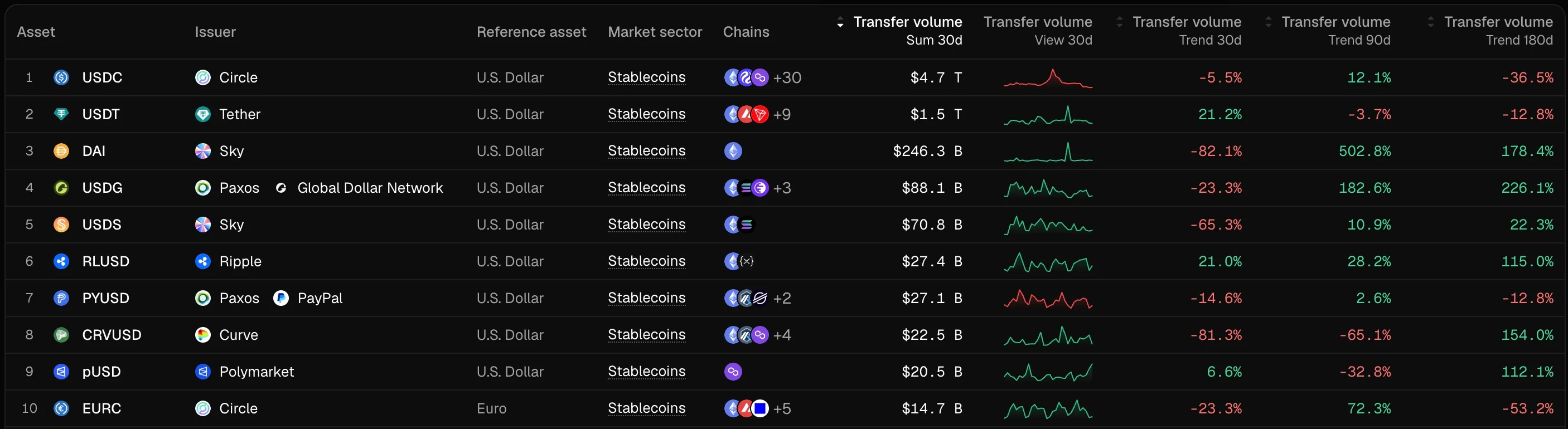
Against this backdrop, fresh metrics from the rwa.xyz analytics dashboard highlight a unique structural paradox. With a net capitalization of $2,401,976,892, the new token took 8th place in the global stablecoin ranking and is already breathing down the neck of a similar project from PayPal ($3.01 billion).
Yes, on the scale of the global market of $289.24 billion, Ripple's share is still a modest one percent against the backdrop of the total dominance of the giants Tether ($181.5 billion) and Circle ($69.7 billion). But within its home walls, in the XRP Ledger (XRPL) registry, the asset has established an absolute monopoly, taking over more than 92% of all stablecoin turnover.
In essence, this weekly surge in volumes clearly showed how a narrow-niche instrument, thanks to the right legal wrapper, turns into the main working bridge between classical banking and decentralized markets.