What to watch, what to ignore
When the 2026 FIFA World Cup opens across the United States, Canada, and Mexico on June 11, crypto traders will share their attention with one of the world's most-watched sporting events for the next 38 days [1]. This piece is not a forecast. It will not tell you whether Bitcoin rallies in July or where fan tokens close the month.
There is also a limit worth stating upfront: extrapolating from the 2018 and 2022 World Cup samples to 2026 is methodologically broken. The reasons unfold across the sections below. What this piece offers instead is a four-dimension framework for observing how crypto markets actually behave during a 38-day global attention sink.
What to watch. Time-zone volume distribution. Perpetual Futures funding rate dislocations. Stablecoin flow direction. Onchain prediction market activity.
What to ignore. Any claim — including ones grounded in 2018 or 2022 data — that promises a directional answer before the event begins.
1 · A structural shift in time-zone volume distribution
Crypto trades twenty-four hours a day, but spot volume is not evenly distributed across regions — and that distribution has changed materially over the past five years.
Kaiko Research's 2025 work shows the U.S. trading session now accounts for over 55% of BTC-USD spot volume, up from 39% in 2020. Weekend share has compressed from a 2021 high of 21% to 12.8% in 2024, stabilizing around 13.3% in 2025 [2]. The structural driver is the launch of U.S. spot Bitcoin ETFs in January 2024, which channeled institutional flow along the New York trading calendar. Kaiko also notes that the U.S. weekday close alone accounts for over 6.6% of total BTC volume on benchmark exchanges, compared with about 4% on weekends [3].
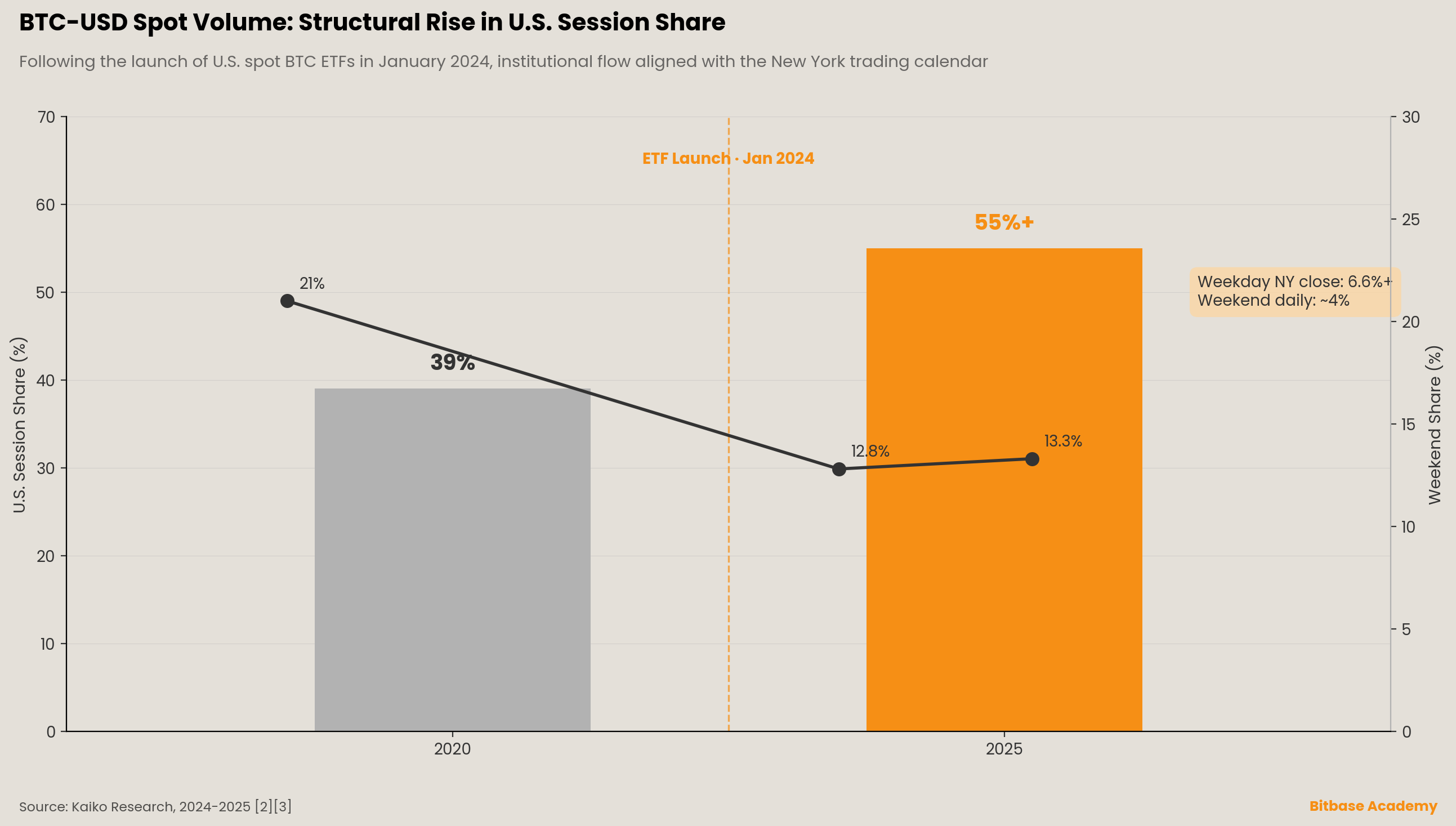
This structural shift has direct implications for observing the 2026 World Cup window.
The 2018 Russia tournament broadcast mostly in European afternoon-to-evening hours, mapping to deep night and early morning in Asia. The 2022 Qatar tournament pushed kick-offs into the Asian evening. In both cases, the broadcast window fell in geographic sessions where crypto activity was structurally less dense. The 2026 tournament will be hosted across North American time zones — most matches will broadcast in European evening and U.S. afternoon-to-evening, which now coincides with crypto's dominant trading session. This is the first World Cup in which the live-broadcast window overlaps the dominant trading window for crypto.
What this means for observation: if the World Cup's attention externality is real, 2026 should show identifiable deviations in U.S.-session volume share, ETF creation/redemption windows (clustered around 3-4 pm New York time), and spot depth metrics [3]. Historical patterns from 2018 and 2022 do not transfer cleanly. The observation tool itself works; what changes is the time-of-day where the deviation should appear, and that window has to be re-calibrated against the first two weeks of June 2026 data.
2 · Funding rates: a sentiment signal, and a case study in signal contamination
Perpetual Futures, offered on Bitbase and other major venues as one of the core derivatives products, differ from traditional futures in one respect: they have no expiry.
To keep the perpetual price anchored to spot, the market uses a funding rate mechanism. At fixed intervals — eight hours on most venues — longs pay shorts when funding is positive, and shorts pay longs when funding is negative.
The default interest-rate baseline on major venues sits at roughly 0.01% per 8-hour cycle, annualizing to about 10.95% [4]. Industry convention treats ±0.01% to ±0.05% per 8h as the normal range, readings above ±0.05% as a deviation signal, and readings above ±0.10% as crowded directional leverage [5][6].
Here is the observation that matters for the section. During the 2022 Qatar World Cup window, BTC perpetual funding rates did show extreme dislocation — a sustained negative funding regime whose depth and duration had not been seen since March 2020, persisting until December 25, 2022, exactly one week after the Argentina–France final [7][8].
But that dislocation had nothing to do with the World Cup.
FTX filed for bankruptcy on November 11, 2022 — nine days before the tournament kicked off [9]. The derivatives deleveraging, stablecoin withdrawal, and broad sentiment collapse that followed dominated funding rates through November and December. BTC hit a two-year low of $15,480 on November 22, 2022 [10]. No published research as of this writing attributes any portion of the November–December 2022 funding extremes to the World Cup. FTX is the only identifiable driver attributed by independent research at the time.
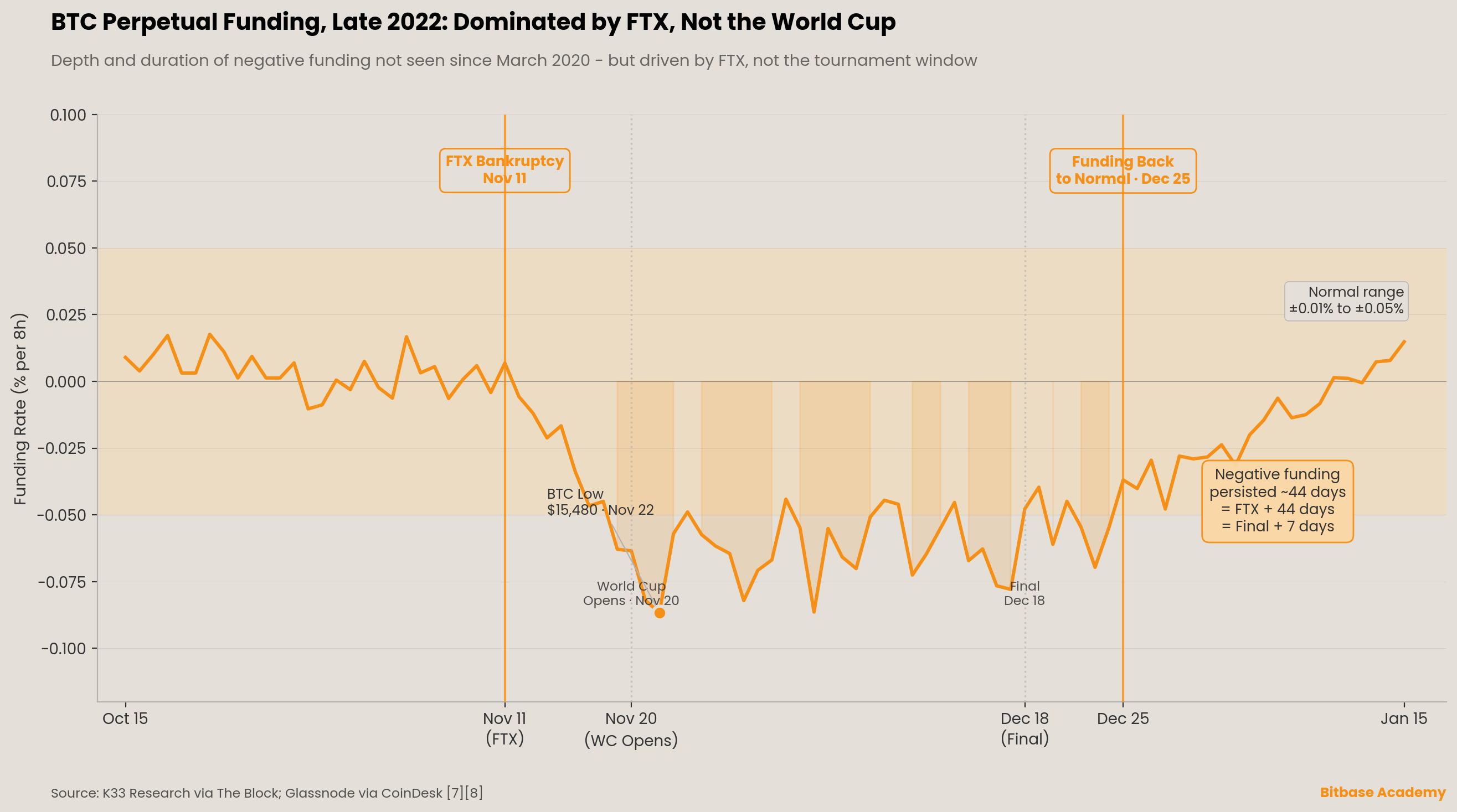
The case study's value isn't in telling traders what happens to funding rates during a World Cup. It's in teaching a more fundamental piece of analytical discipline: when two events overlap in time, neither can be cleanly attributed as the cause of observed price behavior. This “co-located but contaminated” sample is endemic to event-driven analysis. Recognizing it is the first rule of working through event windows.
Back to 2026. If the World Cup window is free of competing macro or crypto-internal events, funding rate deviations (if they appear) will be more cleanly attributable than they were in 2022. If competing events do appear — an FOMC decision, a major regulatory ruling — the attribution work has to come first, and the tournament effect can only be assessed after that.
3 · Stablecoin flows: a steadier signal, and the same contamination problem
Stablecoin flows are harder to move with sentiment than either price or funding. USDT and USDC are two major dollar-equivalent instruments in crypto, and where they move — between exchanges, across chains, and across the fiat boundary — reflects something closer to capital movement than to emotional positioning.
Three observable categories matter:
1. Net stablecoin flow into or out of centralized exchanges, a rough proxy for capital arriving at or leaving the trading layer
2. Onchain stablecoin settlement volume, capturing peer-to-peer activity outside the exchange perimeter
3. Stablecoin–fiat conversion flow at on/off-ramps, reflecting the rate at which new capital genuinely enters or exits the ecosystem
Stablecoin data during the 2022 Qatar World Cup window is contaminated in the same way §2 was. CryptoQuant data shows that in the weeks following FTX, centralized exchange stablecoin reserves saw net outflows of roughly $6.2 billion. USDC market cap contracted from approximately $56.2 billion at the time of FTX's collapse to roughly $24.5 billion by the end of 2023 — a drawdown of over $31 billion. USDT supply alone decreased by about $2 billion in December 2022, among the larger single-month USDT contractions in the post-FTX period [11][12][13].
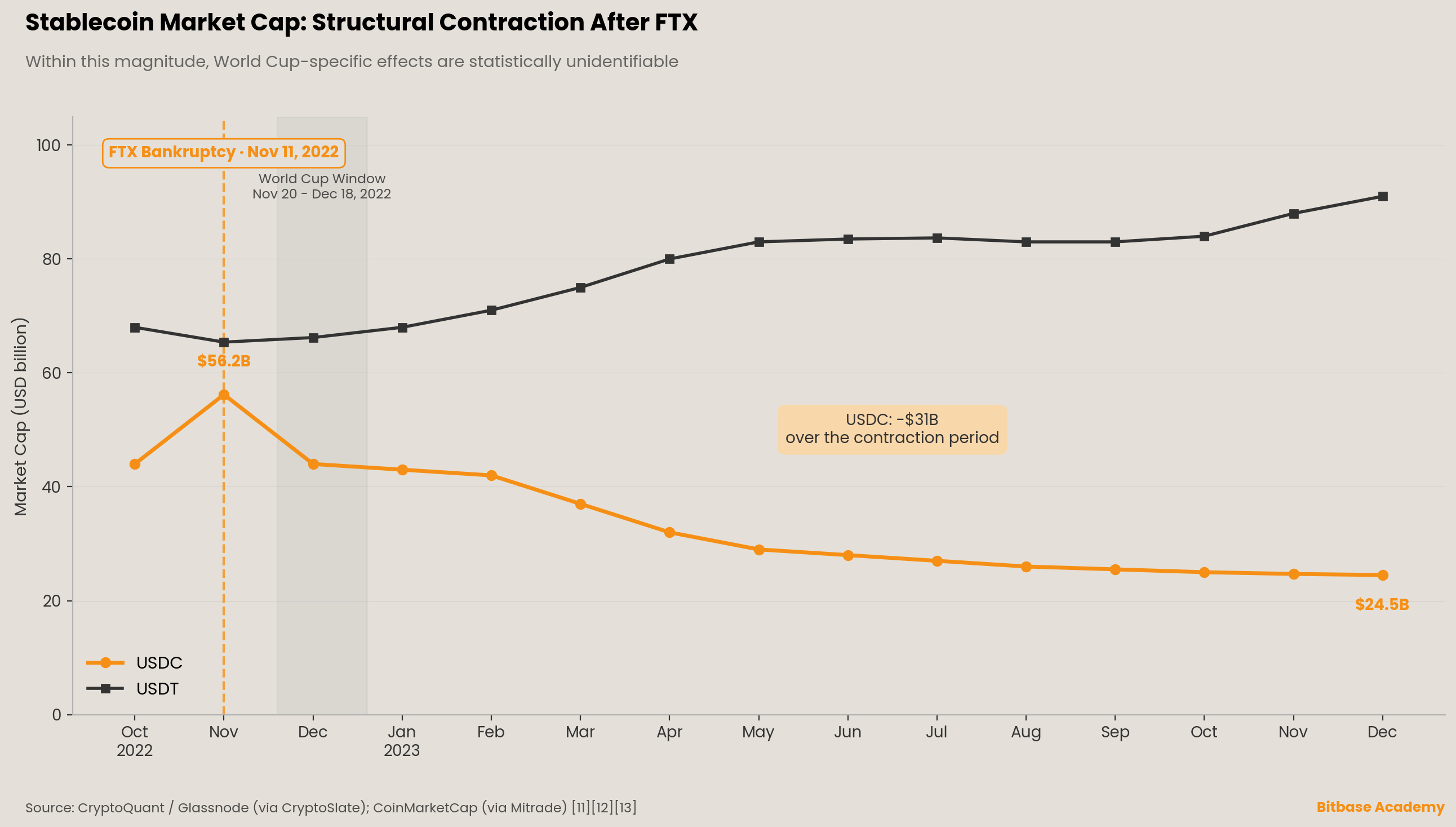
The magnitude of these flows dwarfs anything the tournament itself could have driven. November–December 2022 stablecoin data is not a usable sample for World Cup attribution — same co-located-but-contaminated problem.
What to track in 2026 instead. Watch these three series in parallel:
First, USDT/USDC net flows on major exchanges in the two weeks before kick-off versus during the tournament.
Second, onchain stablecoin settlement volume on match days (especially knockout-round dates) versus non-match days.
Third, Tether's reported issuance/redemption activity and Circle's USDC reserve changes during the tournament window for any deviation from baseline.
Stablecoin trading pairs on Bitbase spot markets are one source of exchange-side activity, and onchain stablecoin data sits next to it. Sentiment can reverse inside 24 hours. The direction of capital is harder to hide — provided no larger external event contaminates the read.
4 · Onchain prediction markets: from microscale experiment to institutional capacity
Prediction markets let users take positions on the outcome of future events, with price itself representing the market's implied probability of occurrence. Polymarket, built on Polygon, and Kalshi, a CFTC-regulated event contract exchange based in the United States, are two major venues for prediction market activity.
The central observation in this section is that prediction market infrastructure underwent an order-of-magnitude expansion between 2022 and 2026.
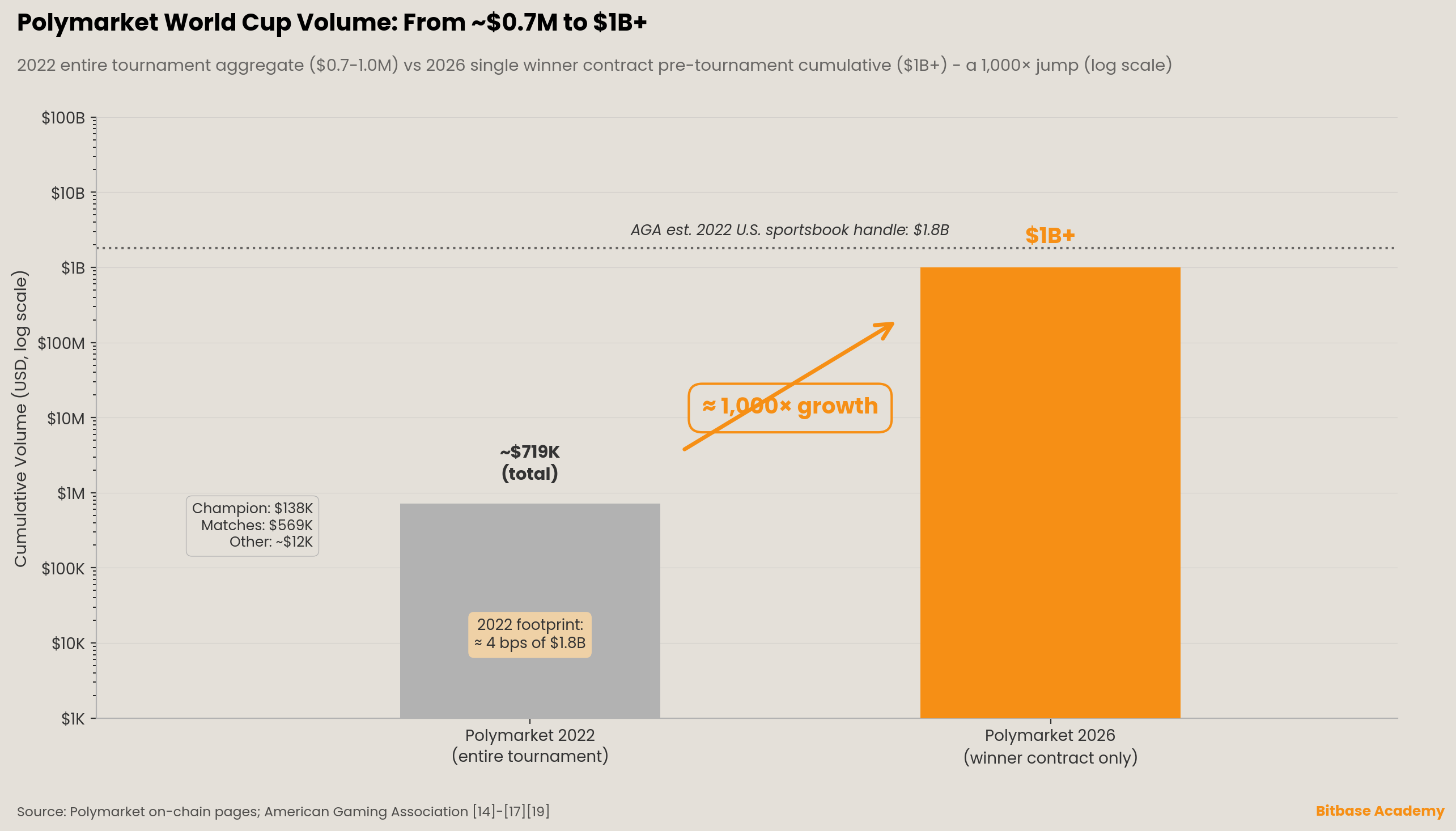
Polymarket's total trading volume across the 2022 Qatar World Cup window was approximately $0.7 to $1.0 million — a bottom-up sum from publicly listed market pages (“Which country will win the 2022 World Cup?”: ~$138,264; “World Cup Matches”: ~$569,100; smaller satellite markets totaling several thousand more) [14][15][16]. The American Gaming Association estimated that U.S. adults alone planned to wager approximately $1.8 billion on the 2022 tournament [17]. Polymarket's entire 2022 World Cup footprint amounted to roughly four basis points of just the projected U.S. sportsbook handle.
By 2024, Polymarket reached approximately $9 billion in annual cumulative volume, with a single-month high of $2.63 billion in November 2024 [18].
As of May 2026 — about three weeks before the tournament begins — Polymarket's “2026 FIFA World Cup Winner” market alone has crossed $1 billion in cumulative volume [19]. That's roughly 1,000× the entire 2022 World Cup footprint, on a single contract, before the first match.
Kalshi's path was different but the conclusion is the same. Following the September 2024 D.C. Circuit ruling that cleared political event contracts under CFTC oversight [20], Kalshi filed sports-event contract self-certification with the CFTC on January 22, 2025, and went live with sports contracts in all 50 U.S. states on January 23, 2025 [21][22].
The volume trajectory followed: monthly volume crossed $1 billion for the first time in mid-September 2025, with 98% of that volume coming from sports contracts [23]. By November 2025, monthly volume reached $5.8 billion [24]. January 2026 hit $9.6 billion — a 45% month-over-month increase [25]. Super Bowl LX in February 2026 saw $2.8 billion in Kalshi weekly volume, with Super Bowl Sunday alone exceeding $1 billion in a single day — a 2,700% year-over-year increase [26]. Combined Kalshi + Polymarket Super Bowl-related volume reached $1.38 billion [26].
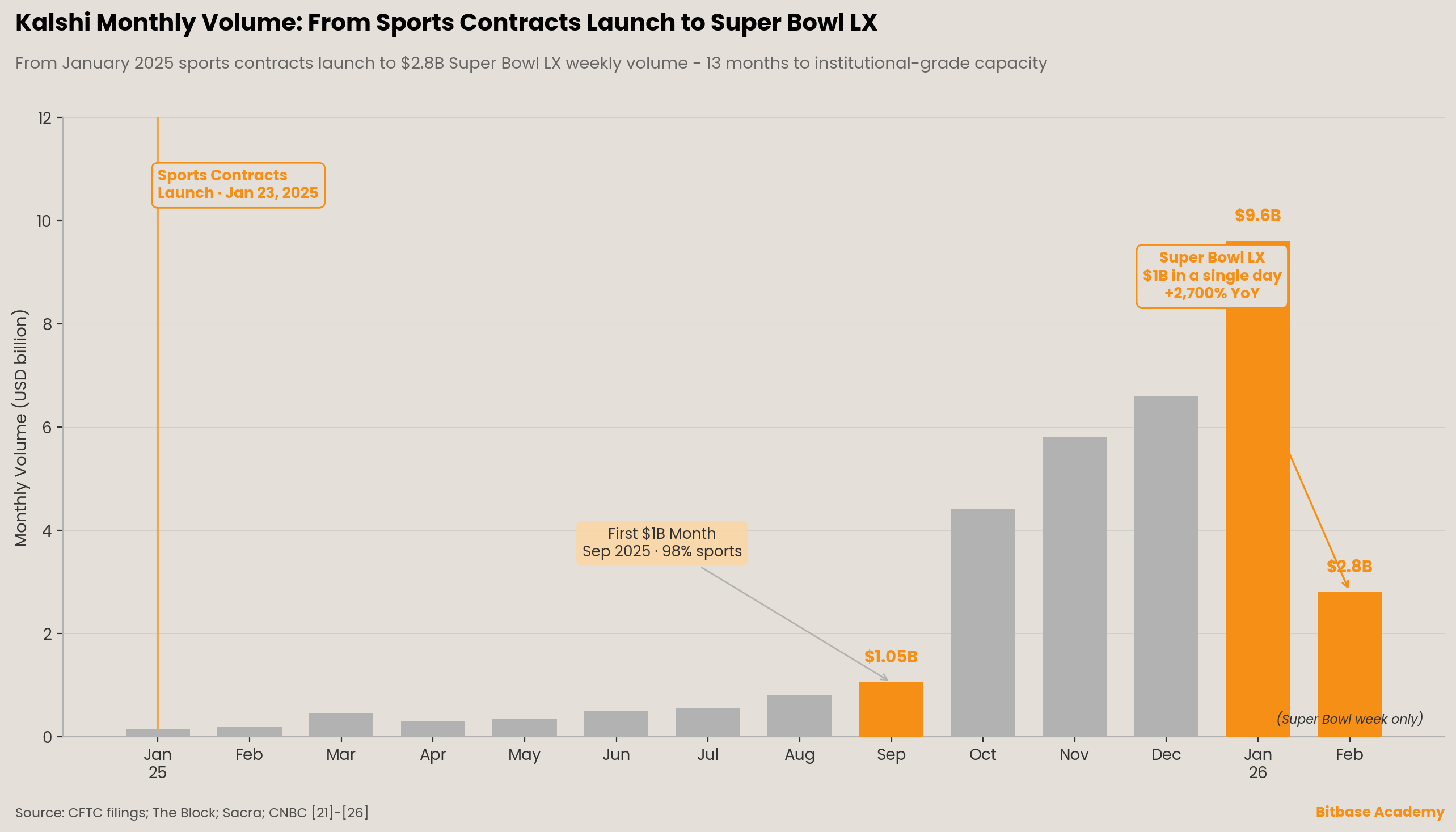
This sequence resolves a long-running skepticism about whether prediction market infrastructure can carry mainstream sports event volume. Super Bowl LX demonstrated that it can.
For crypto traders, the value of prediction markets is not in betting on match outcomes. It is in having an independent probability-pricing window operating apart from spot and derivatives. When sentiment indicators on perpetual futures diverge from implied probabilities on prediction markets — say, crowded short positioning alongside rising implied probabilities of crypto-positive macro events — that divergence is a useful starting point for thinking about market structure.
For July 2026, observable data points include: Polymarket volume distribution across World Cup outcome contracts, Kalshi implied probabilities across group-stage and knockout-round contracts, odds spreads between Polymarket and Kalshi for the same event, and the correlation between these series and crypto spot volume across the same window. All of it is public. All of it is independently traceable through each platform's official site and through Dune.
Closing · Why 2026 is worth its own observation sample
This article does not predict the direction of crypto markets during the 2026 World Cup. It does not offer trading strategies. What it offers is a four-dimension observation framework — time-zone volume distribution, perpetual funding, stablecoin movement, prediction markets — that a reader can apply independently across the tournament window.
The framework was not built for the World Cup. Any event with strong attention externality — a U.S. presidential election, an FOMC decision, a major regulatory ruling — invites the same four questions. Once internalized, the framework continues to apply after July 19.
But the 2026 World Cup is a uniquely useful sample. Three conditions are aligning for the first time: a host calendar in North America (broadcast windows overlapping crypto's dominant trading session), prediction market infrastructure that has cleared institutional capacity (validated by Super Bowl LX), and — based on what is visible as of May 2026 — no major foreseeable crypto-internal catalyst expected in the June–July window. That suggests 2026 will produce a closer-to-clean observation sample than 2018 or 2022 ever could, provided no macro or regulatory surprise intervenes.
A necessary admission
What this article offers is an observation toolbox, not a prediction toolbox.
First, event-window market behavior is shaped by macro liquidity, geopolitics, and the regulatory cycle. The four dimensions above do not exhaust the explanatory paths.
Second, both prior World Cup samples carry structural limits — 2018 fell in a bear market overlapping with the post-ICO regulatory cycle, and 2022 was co-located with the FTX bankruptcy (as Sections 2 and 3 demonstrate). Neither constitutes a clean observation of World Cup–specific effects on crypto. This is exactly why this article emphasizes that 2026 is a fresh sample.
Third, the trading scale of Polymarket and Kalshi remains in rapid flux. The 2022-to-2026 jump does not commit the future. If regulatory, liquidity, or technical shocks arrive between 2026 and 2028, the usefulness of prediction markets as an observation tool will have to be reassessed.
Bitbase Research plans to publish an event review after the tournament concludes, revisiting each claim in this piece against the data.
Disclosure
This article is Bitbase Academy educational content. It introduces a market observation framework and methodology. It does not constitute investment advice, trading recommendations, or specific operational guidance. Crypto asset trading involves significant risk, including but not limited to market volatility, liquidity risk, and the possibility of total loss of principal. Readers should make independent judgments based on their own risk tolerance. The historical data and third-party platform data referenced in this article may change after publication.
Related reading
Other Bitbase articles on this topic:
- After the Final Whistle: How the World Cup's First Match Settled On-Chain
- Football Stars and Crypto Endorsements: A Five-Year Observation of a Business Category
- The Probability Inside the Price: How World Cup Odds Are Actually Made
References
[1] FIFA, "2026 FIFA World Cup Match Schedule and Host Cities." fifa.com
[2] Kaiko Research, "Bitcoin Booms in Low-Risk Environment," 2025. research.kaiko.com
[3] Kaiko, "BTC ETFs' Impact on Spot Market Structure," 2024. kaiko.com
[4] ApeX Exchange Blog, "Funding Rates: Essentials of Perpetual Futures Trading," 2024. apex.exchange
[5] Blackperp, "Bitcoin Funding Rate — Live BTC Perpetual Futures Data," 2025. blackperp.com
[6] Bitget Academy, "Bitcoin Funding Rates: How to Track & Interpret Perpetual Futures Data," 2024. bitget.com
[7] The Block / K33 Research (Vetle Lunde), "Bitcoin perpetual futures reflect market pessimism as funding rates stay below neutral," September 2024. theblock.co
[8] CoinDesk (citing Glassnode), "Bitcoin funding rates turn most negative since 2023, signaling potential market bottom," April 16, 2026. coindesk.com
[9] CoinDesk (Nansen data), "These Four Key Charts Shed Light on the FTX Exchange's Spectacular Collapse," November 9, 2022. coindesk.com
[10] CNBC (Coin Metrics data), "Bitcoin (BTC) hits 2-year low as FTX collapse contagion fears linger," November 22, 2022. cnbc.com
[11] CryptoSlate (citing CryptoQuant / Glassnode), "Stablecoin reserves in centralized exchanges continue to fall after FTX collapse," November 2022. cryptoslate.com
[12] Mitrade (CoinMarketCap data), "USDC finally makes full recovery from FTX market crash," February 8, 2025. mitrade.com
[13] Cointelegraph, "Tether USDT Set for Biggest Monthly Decline Since FTX Collapse," 2025. cointelegraph.com
[14] Polymarket, "Which country will win the 2022 World Cup?" Resolved December 18, 2022. polymarket.com
[15] Polymarket, "World Cup Matches," resolved December 18, 2022. polymarket.com
[16] Polymarket, "Will there be a major upset in the World Cup group stage qualification?" Resolved December 2022. polymarket.com
[17] American Gaming Association, "2022 FIFA World Cup Wagering Estimates" (Morning Consult survey, November 3-5, 2022, n=2,213). americangaming.org
[18] The Block, "Polymarket's huge year: $9 billion in volume and 314,000 active traders redefine prediction markets," January 2025. theblock.co
[19] Polymarket, "2026 FIFA World Cup Winner Predictions & Odds," accessed May 2026. polymarket.com
[20] Brownstein Hyatt Farber Schreck, "Kalshi v. CFTC Challenges Contracts on Political Events," 2025. bhfs.com
[21] CFTC Filing Portal, "KalshiEX LLC Submission, January 22, 2025 — 'Will <team> win <title>?' Contract." cftc.gov
[22] SBC Americas, "Kalshi Launches Sports Event Contracts Amid CFTC Scrutiny," January 23, 2025. sbcamericas.com
[23] Sacra, "Polymarket funding, news & analysis," 2025. sacra.com
[24] Yahoo Finance / The Block, "Kalshi, Polymarket Post Record $10B in Volume in November," December 2025. finance.yahoo.com
[25] The Block, "Kalshi inks sports hedging deal with Game Point on the heels of over $1 billion in Super Bowl trading," February 2026. theblock.co
[26] CNBC, "Kalshi says Super Bowl trading volume surpassed $1 billion," February 10, 2026. cnbc.com