Publication date: July 23, 2026 · Bitbase Research
For related Bitbase Research on this subject, see Decentralized AI Infrastructure.
Executive Summary
"AI crypto" is the most heavily narrated sector in the market and one of the least disciplined in its valuation. By April 2026 one widely used sector screen counted roughly 919 tracked projects with a combined capitalization near US$22.6 billion, while looser screens put the twenty largest AI tokens alone at US$40–60 billion — the same sector, measured two ways, differing by nearly three times [1][21]. That disagreement about how big the sector even is makes the first point for us. The phrase "AI token" describes a marketing category, not an asset class: a decentralized GPU-rental network, an inference marketplace, an autonomous on-chain agent, and a data-labeling protocol have almost nothing in common in how they earn, how value reaches the token, or what a fair multiple looks like. Treating them as one basket is the first and most expensive analytical error, and it is the one the narrative actively encourages.
This report replaces the narrative with a discipline in three moves. First, it breaks the sector into four subsectors — compute, inference, agents, and data — each with a distinct revenue engine and therefore a distinct valuation anchor [1][21]. Second, it insists that price be tied to usage, not story, and grounds that insistence in the oldest quantitative tool available for token valuation, the monetary equation of exchange MV = PQ, whose central lesson — that token velocity, not headline adoption, sets how much value a network of a given size can support — explains why so many "high-usage" AI tokens still fall [9][10][11]. Third, because AI tokens are overwhelmingly emission-subsidized, it adds an incentive-sustainability score that separates revenue a network truly earns from supply it merely prints, the exact distinction the DePIN compute sector spent 2026 learning the hard way as it pivoted from token mining to real cash flow [4][26].
The stakes are concrete because, for the first time, several of these networks have real numbers to value. Published estimates of decentralized-compute revenue diverge by definition rather than by rounding: roughly US$180–220 million annualized on the narrower protocol-revenue measures, against Render alone reporting about US$38 million for January 2026 — a ~US$450 million annual run-rate — on a gross-network-billings basis across some 5,600 active GPU nodes, while Akash's usage grew 428% year-over-year with GPU utilization above 80% [4][5][6]. Which measure enters the multiple is a modelling choice the analyst has to make explicitly, because the two differ by more than a factor of two. Bittensor's dynamic-TAO upgrade turned emissions market-driven and spawned over 120 subnets against 32 a year earlier, and the network booked around US$43 million of real AI-service revenue in Q1 2026 [3]. These are the inputs a usage multiple needs. At the same time the agent subsector — Virtuals, ai16z, AIXBT and peers — trades 55–85% below its highs on almost no recurring revenue at all, a reminder that the framework's job is to rank, not to flatter [17]. Everything here is educational analysis, not investment advice.
Part 1 · Why "AI token" Is a Category Error
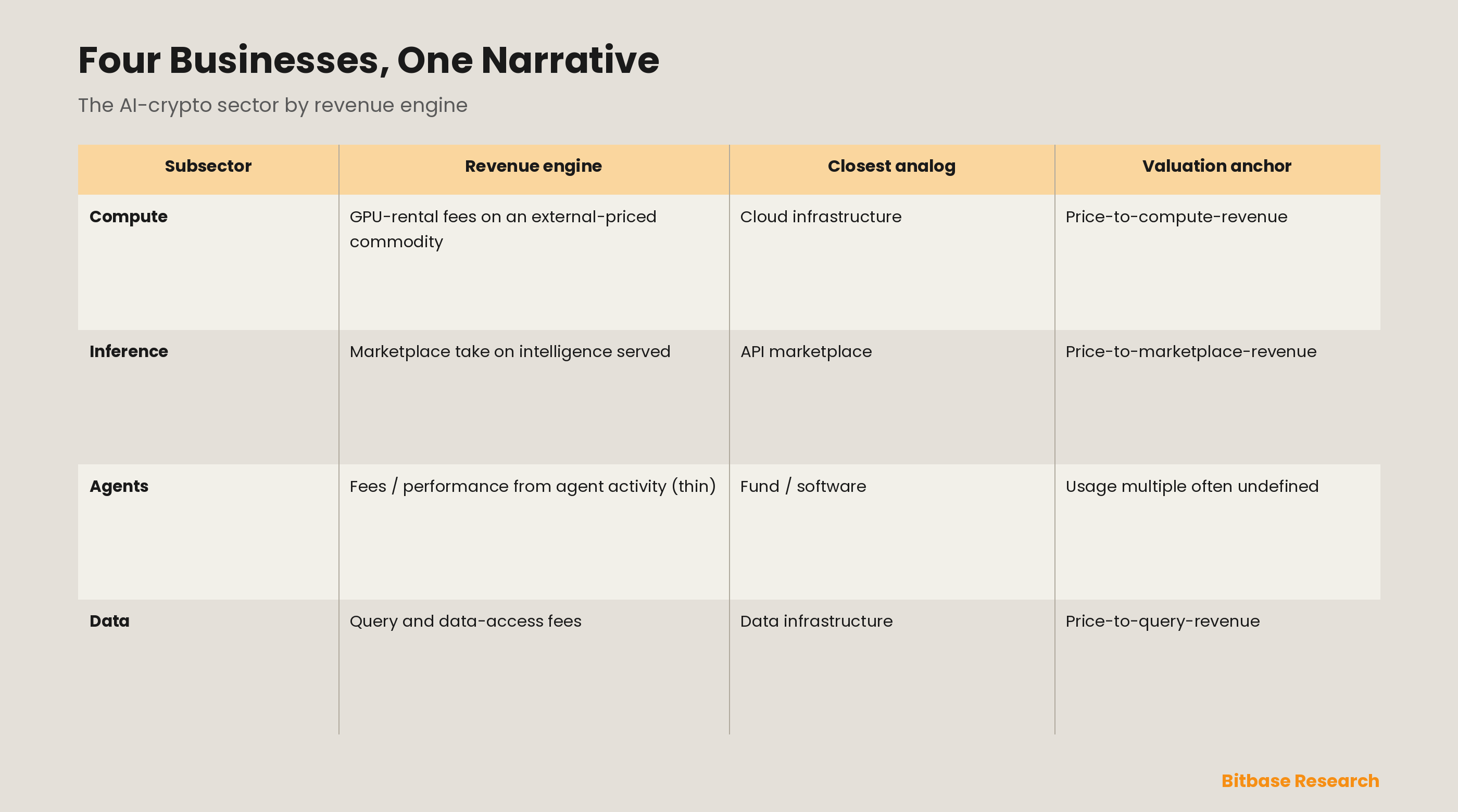
Precision about what a token is precedes any estimate of what it is worth, and the AI label obscures rather than reveals that. The four things the market files under "AI crypto" are four different businesses. A compute network like Render or Akash rents GPU cycles: its revenue is a usage fee on a commodity with a real-world price, and its closest analog is a cloud-infrastructure firm [5][6][7]. An inference or model network like Bittensor pays participants to produce machine-intelligence outputs and charges for their consumption: its revenue is a marketplace take on intelligence served, closer to an API business [3]. An agent token like Virtuals or ai16z represents an autonomous program that transacts on-chain: its "revenue," where any exists, is fees or performance from the agent's own activity, and its analog is closer to a fund or a piece of software than to infrastructure [17]. A data protocol like The Graph or Grass sells indexed or collected data into the AI pipeline: its revenue is a query or data-access fee [1][21].
These are not shades of one thing. They differ in what they sell, who pays, how defensible the margin is, and — critically — whether the token has any claim on the money at all. Collapsing them into a single "AI" multiple is how a data-indexing protocol earning real query fees ends up trading at the same narrative premium as an agent token with a Twitter following and no cash flow. The sector's celebrated correlation — nearly every token in the group trades 55–85% below its all-time high in mid-2026 regardless of fundamentals — is itself evidence that the market has been pricing the narrative as one factor rather than pricing four different businesses on their four different merits [17]. The analyst's first act is to un-collapse the basket.
Part 2 · A Sector Taxonomy: Compute, Inference, Agents, Data
The taxonomy is the framework's backbone because it assigns each token the right valuation question before any number is computed.
Compute is the most mature and the most measurable. Decentralized GPU networks rent rendering and AI-training capacity, and they win business for a simple, durable reason: they undercut hyperscalers by 60–90% on comparable on-demand pricing, with Render's inference pricing independently benchmarked around 70% below comparable Azure Machine Learning compute [7]. Demand is real and visible on-chain — Render's roughly US$38 million January 2026 monthly revenue, 5,600 active nodes and 67 million-plus cumulative frames rendered; Akash's 428% year-over-year usage growth and 80%-plus utilization — and it tracks a genuine macro shortage, since AI compute demand has been outpacing supply, opening the exact gap these networks fill [4][5][6][8]. Compute is where usage multiples are most trustworthy because the revenue is a fee on a commodity with an external price.
Inference and open model networks sit one layer up the stack. Bittensor is the reference case: its dynamic-TAO (dTAO) redesign in 2025 made subnet emissions market-driven and introduced subnet tokens, and the ecosystem expanded past 120 active subnets from 32 a year earlier, crossing US$1.5 billion in combined subnet capitalization and generating about US$43 million of real AI-service revenue in Q1 2026 [3]. The valuation question here is a marketplace take-rate on intelligence served, complicated by a two-level token structure (TAO plus subnet tokens) that the analyst must consolidate rather than double-count.
Agents are the newest and the least anchored. Virtuals lets users spin up autonomous agents, ai16z runs an AI-managed DAO, and AIXBT generates trading signals — genuinely novel, but with revenue that is thin, non-recurring or absent, and the group's 55–85% drawdowns from its highs reflect exactly that [17]. Agents are where narrative premium is largest and where the framework must be most skeptical, because "the agent could earn fees someday" is a discounted-expectation claim, not a usage fact.
Data protocols feed the pipeline the other three depend on. The Graph indexes blockchain data for applications; Grass collects and routes web data for AI training [1][21]. Their revenue is a query or access fee, and their value question resembles a data-infrastructure business with a metered API. The four subsectors, side by side, make the point the label hides: same narrative, four revenue engines, four multiples.
Part 3 · The Valuation Problem: Equation of Exchange and the Velocity Trap
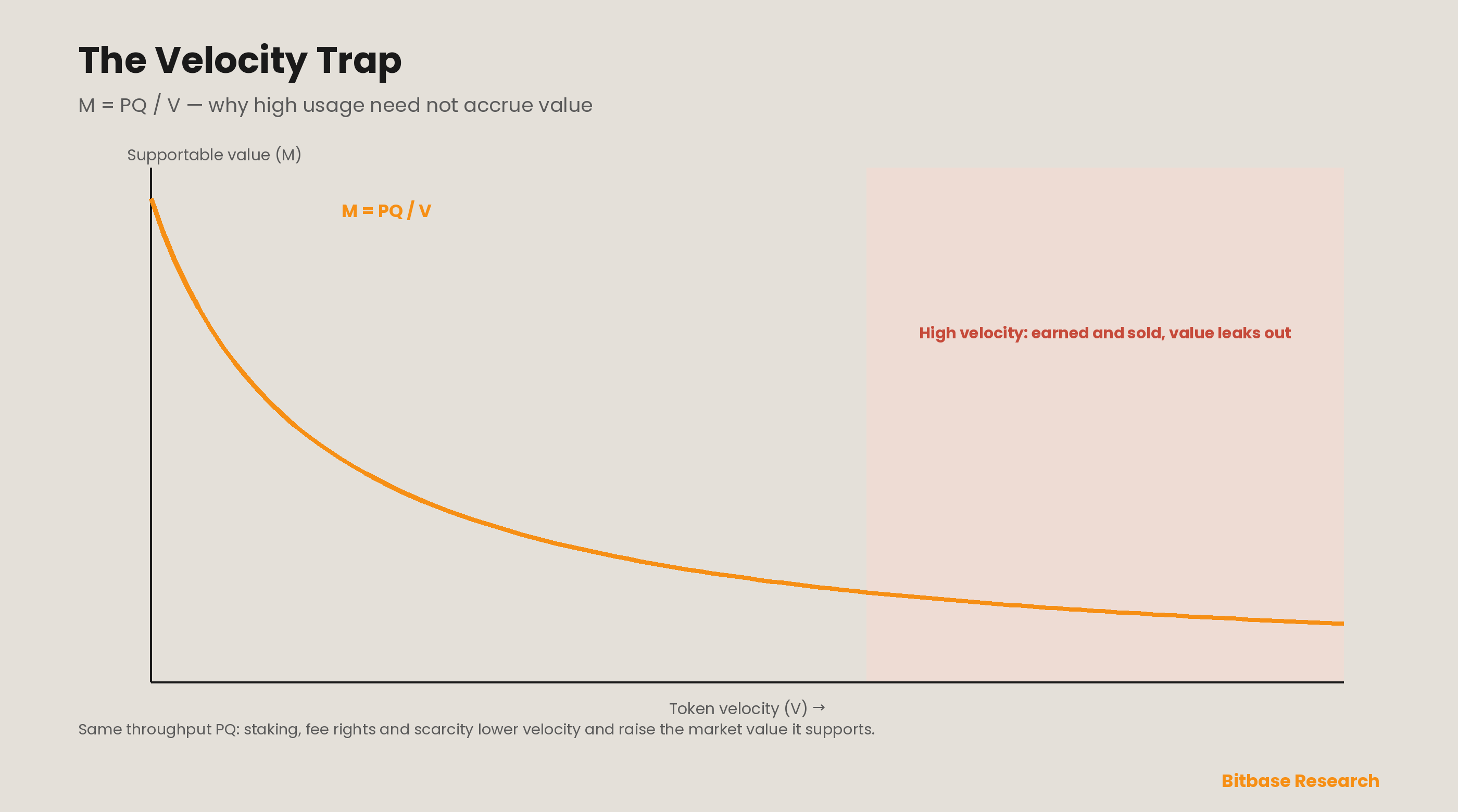
Once tokens are sorted, the question is how to value one, and here AI crypto inherits the whole unsolved problem of token valuation. Equities have a century of discounted-cash-flow and multiples theory; most tokens do not even grant a claim on the cash flows they help generate. The oldest serious tool is the monetary equation of exchange, MV = PQ, imported from Fisher's quantity theory and adapted to crypto by Chris Burniske's INET model: rearranged, M = PQ / V, where the market value a network can support (M) equals the size of the economy transacted through the token (PQ) divided by the token's velocity (V) [9][12]. The model splits value into a current utility component (CUV), reflecting present usage, and a discounted expected utility component (DEUV), reflecting the market's bet on future usage [9]. Empirical work has since tried to fit the identity to on-chain data rather than assume its inputs, sharpening it from a thought experiment into something testable [10].
The identity carries one lesson that dominates AI-token analysis: velocity is the silent destroyer of value. If a token is used purely as a medium of exchange — earned by a GPU provider and immediately sold for dollars — its velocity is high, and high V collapses the M the same PQ can support [11]. This is why "our network processed X of usage" is not, by itself, a bullish fact: if every unit of usage passes through the token at high velocity and exits, the sustainable market value is a fraction of the flow. The tokens that hold value are those that give holders a reason to not sell — staking, fee rights, governance with teeth, or genuine scarcity against demand — lowering V and raising the M a given PQ supports. Bittensor's fixed 21-million cap and staking-heavy design are, in equation-of-exchange terms, a velocity-suppression mechanism; an agent token with no staking and pure medium-of-exchange use is a velocity-maximizing one [3][11]. The framework treats velocity as a first-order input, not an afterthought.
Part 4 · Usage-Based Multiples: The Right Numerator for the Right Subsector
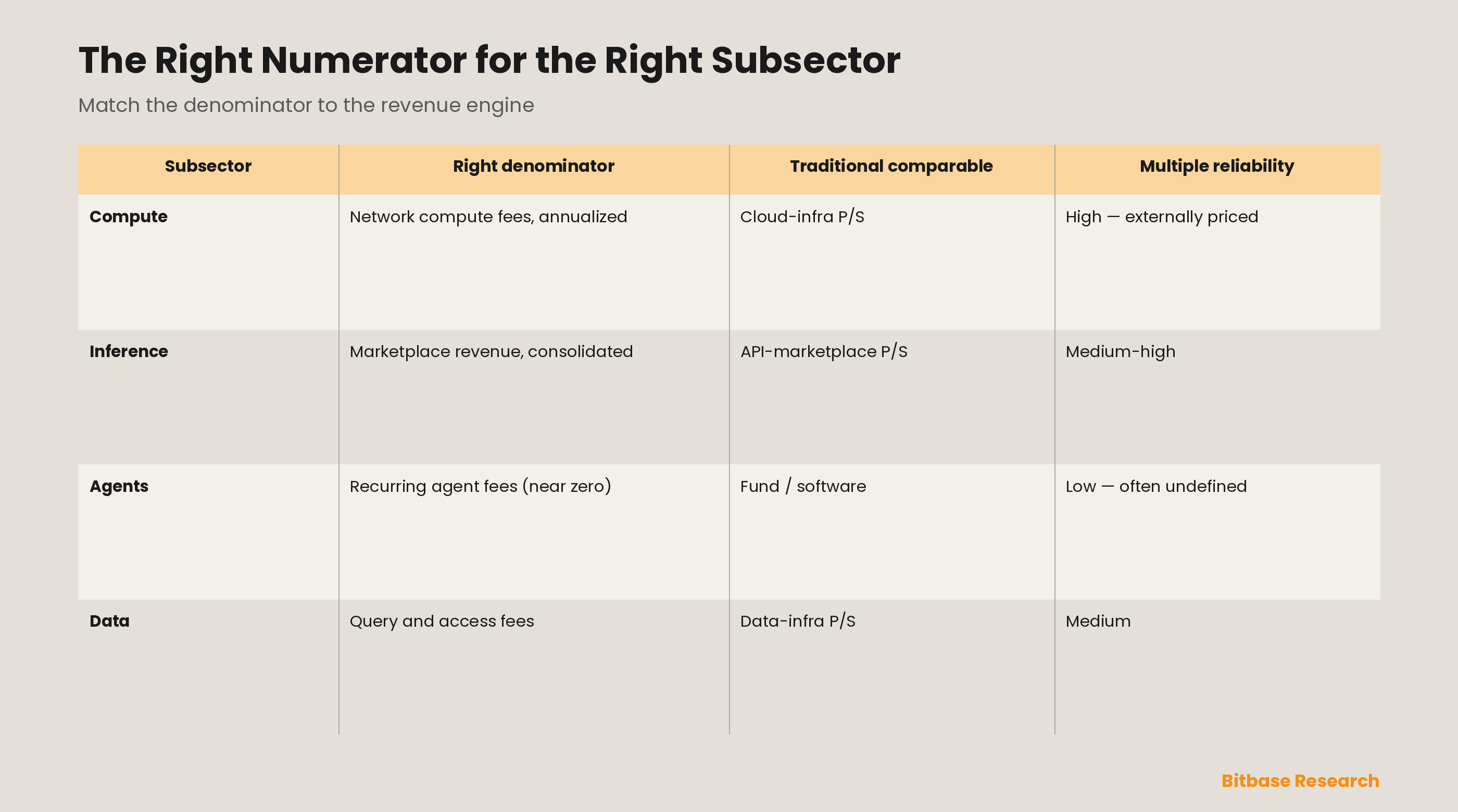
With velocity respected, the practical tool is a usage multiple — the crypto analog of price-to-sales — but the framework's discipline is that the denominator must match the subsector. Price-to-sales, market value over annualized fee revenue, is already the industry-standard multiple for fee-earning protocols, the way Ethereum and the major DeFi venues are compared, and it exposes how expensive narrative can be: Uniswap's roughly US$5.4 billion valuation against about US$26 million of annualized protocol fees implies a revenue multiple near 207×, a high-growth-tech number for a mature exchange [13]. That is the yardstick, and each AI subsector needs its own version.
For compute, the right denominator is network compute revenue — real fees paid for GPU time — because it is a fee on a commodity with an external price. A price-to-compute-revenue multiple is defensible and cloud-comparable, but only where numerator and denominator use the same revenue definition: Render's ~US$38 million monthly of gross network billings (~US$450 million annualized) and the sector's ~US$180–220 million of protocol revenue are not interchangeable inputs, and substituting one for the other moves the multiple by more than half [4][5]. For inference, the denominator is marketplace revenue from intelligence served — Bittensor's ~US$43 million Q1 real revenue — but consolidated across TAO and subnet tokens so the same activity is not counted twice [3]. For agents, the honest denominator is usually near zero recurring revenue, which is precisely the finding: a usage multiple on an agent token is often undefined or absurd, and the framework should say so rather than invent a story-based number [17]. For data, the denominator is query or data-access fees, a metered-API figure [1][21]. The single most common mistake in AI-token valuation is borrowing a compute-style multiple — anchored in real, external-priced revenue — and applying it to an agent token whose "revenue" is speculative, which manufactures a false equivalence between a cloud business and a narrative.
Part 5 · The Incentive-Sustainability Score: Real Demand vs. Emission Subsidy
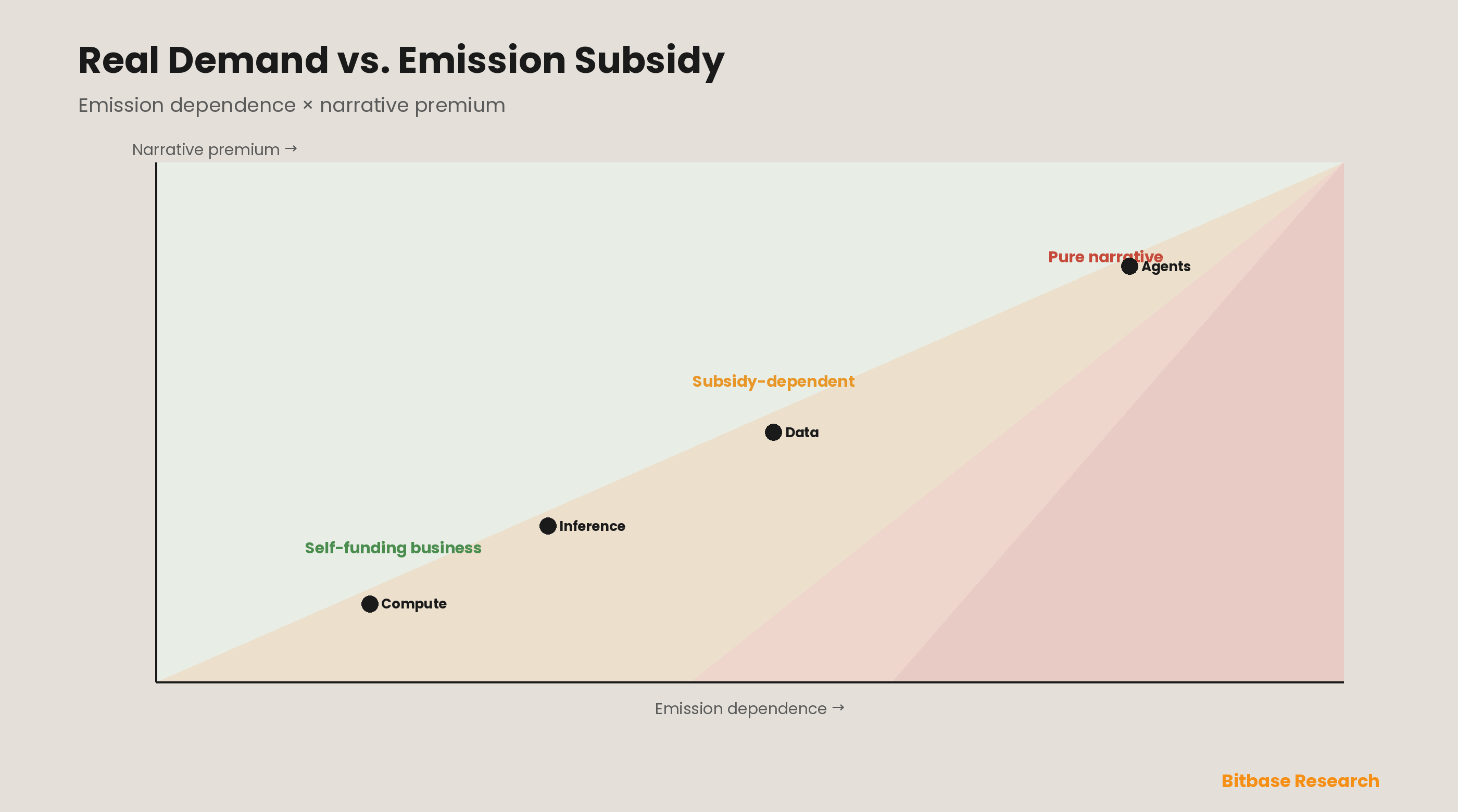
A usage multiple can still deceive, because much of what looks like demand in AI crypto is subsidy: networks pay providers in freshly minted tokens to bootstrap supply, and that emission can masquerade as traction. The DePIN compute sector spent 2026 confronting exactly this, in a widely chronicled "revenue pivot" from token-subsidized growth to real business cash flow — Akash, io.net and Aethir explicitly working to replace token mining with paying customers [4][26]. The framework's second instrument, the incentive-sustainability score, is built to see through the subsidy by asking, for each network, how much of the token's emission is matched by real external revenue versus how much simply inflates supply to pay for its own usage.
The mechanics matter because they connect to value accrual, the deepest problem in the whole exercise. Even a network with real revenue may pass none of it to the token: holders often have no claim on protocol cash flows unless governance explicitly grants one, so a "revenue" narrative can coexist with a token that captures nothing [14]. Buyback-and-burn and fee-switch models attempt to close that gap by tying token destruction to protocol income — Uniswap's move to activate its fee switch is the reference case of a governance token reaching for value accrual [13][14]. But the accrual is only real if it is net: a protocol that buys back 5% of supply while unlocking 10% through vesting and staking rewards still dilutes, so the burn is cosmetic [15]. The empirical verdict is sobering and clarifying at once — across tokens, active value-accrual mechanisms outperform governance-only tokens by roughly 10 percentage points on average, but the dominant driver of returns is revenue scale, not mechanism design: protocols that return capital while generating real revenue outperform everything else by a wide margin, and "a high burn rate cannot compensate for zero utility or declining demand" [15][16]. The score therefore ranks a network on two axes at once: the quality of its real, external demand, and the sustainability of its emissions against that demand.
Part 6 · Benchmarking Across Comparables
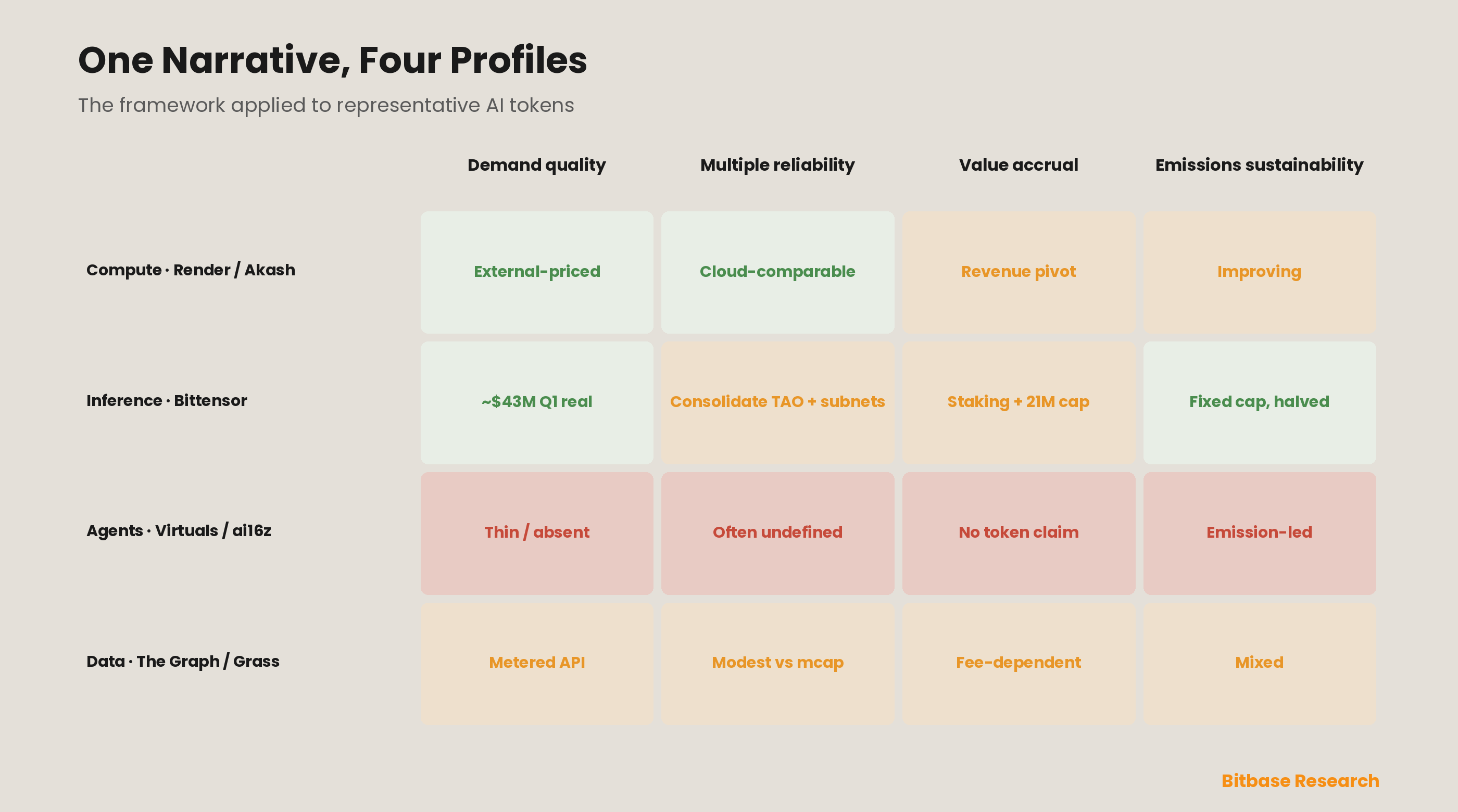
A framework proves itself by ranking real names, and 2026 finally supplied enough real revenue to try. The exercise is to run each representative token through the same four questions — which subsector, what usage multiple on the right denominator, how sound the value-accrual path, and how sustainable the emissions — and let the differences fall out.
Compute scores best on demand quality: Render and Akash earn external-priced revenue that tracks real AI usage, so their usage multiples mean something and their emissions are increasingly covered by customers rather than mining, which is the whole point of the sector's revenue pivot [4][5][6]. The analyst's next step is not to celebrate but to check the net emission and the value-accrual path — real revenue with weak token capture still fails. Inference, led by Bittensor, scores well on real revenue (~US$43 million in Q1) and on velocity suppression (fixed 21-million cap, staking-heavy, halving in December 2025 that cut daily emissions from 7,200 to 3,600 TAO), but demands care to consolidate the TAO-plus-subnet structure and to confirm subnet revenue is genuine rather than intra-ecosystem speculation among 120-plus subnets [3]. Agents score lowest on every axis that matters — thin or absent recurring revenue, no external price anchor, and drawdowns of 55–85% that reflect the market re-pricing narrative toward fundamentals — and the framework's contribution is to state plainly that most agent tokens are DEUV bets with negligible CUV, not usage-backed assets [9][17]. Data protocols sit in between, with metered-API revenue that is real but often modest relative to valuation [1][21]. The specific rankings matter less than the method: the same four questions, applied identically, separate a cloud-comparable compute business from a narrative agent that a single "AI" multiple would price alike.
Part 7 · Limits and Honest Failure Modes
A valuation framework earns trust by naming what it cannot do. The largest limit is that AI crypto is early, and early-stage assets are legitimately dominated by their discounted expected utility, not current utility: a framework anchored in present usage will systematically undervalue a network that is genuinely building toward large future demand, exactly as a strict price-to-sales screen would have dismissed early cloud-computing equities [9]. The score is a discipline against narrative, not a crystal ball for optionality, and it should be read as ranking relative fundamental quality today, not as a verdict on a network's ten-year potential.
Four further limits deserve to be as visible as the framework itself. Data quality: on-chain "revenue" can be gamed — wash-usage, intra-ecosystem transactions among a project's own subnets or agents, and grant-funded demand can all inflate the denominator, and because the multiple is only as honest as its revenue figure, a network that manufactures usage defeats the whole apparatus [3][26]. Token-claim ambiguity: even where revenue is real, the token may have no enforceable claim on it, so a strong business can sit atop a valueless token — the value-accrual question is not a footnote but a gate [14][15]. Reflexivity of the narrative: because "AI" is a coordinated market factor, the group can rise and fall together on sentiment regardless of the fundamentals the framework measures, so the edge is in relative selection within the sector, not in timing the narrative [1][17]. Model humility: the equation of exchange is an identity, not a forecast — its output depends entirely on assumed velocity and future PQ, both of which are unobservable in advance — so serious practitioners treat any point estimate as a scenario, not a target, and our score is deliberately ordinal rather than a precise price [10][11]. As a checklist, the framework sharpens judgment; as a valuation oracle, it will disappoint.
Conclusion · From Narrative to Numerator
AI crypto rewards the analyst who refuses the basket. The narrative treats one factor; the framework treats four businesses, each with its own revenue engine, its own correct denominator, and its own honest multiple [1][21]. Underneath the multiple sits the equation of exchange and its unforgiving lesson that velocity, not headline usage, decides how much value a network of a given size can hold, which is why a token needs a reason to be held and not merely used [9][11]. Around the multiple sits the incentive-sustainability score, which separates revenue a network earns from supply it prints and asks whether any of it actually reaches the token — the value-accrual gate that a real business can still fail [14][15][16]. Between them, the sector taxonomy turns a wall of "AI tokens" into an ordered comparison: name the subsector, put real usage in the right numerator, suppress the narrative premium, and check that emissions are covered by demand rather than the other way around.
The deeper primitives these judgments rest on — how token emissions and vesting are engineered, how a network's circulating float diverges from its fully diluted value, and how fee capture and buyback-burn mechanics actually accrue (or fail to accrue) value to holders — are each worth understanding in their own right, because the score is only as good as the reader's grasp of the mechanics it grades. Treat it as a discipline for ranking fundamental quality within a narrated sector, never as a price forecast, and always alongside the demand and market context that no supply-and-usage framework can capture.
Related reading
Other Bitbase articles on this topic:
- Fan and Social Tokens
- Finding Crypto Narratives Early: A Research Method for Signals, Evidence, and Counter-Evidence
- Social Dominance and Token Mindshare: Measuring Attention
References
[1] CoinDCX, Top AI (Artificial Intelligence) Crypto Coins in June 2026 (sector size, subsector breakdown). coindcx.com
[2] The Motley Fool, "Better AI Crypto: Bittensor (TAO) vs. Render," May 6, 2026. fool.com
[3] TAO Media, The Ultimate Guide to Bittensor 2026 and The Complete Beginner's Guide to Dynamic TAO (dTAO) (subnets, Q1 revenue, halving, 21M cap). tao.media
[4] BlockEden.xyz, "DePIN's Revenue Pivot: From Token Subsidies to Real AI Compute Revenue," April 12, 2026. blockeden.xyz
[5] Own Your Mind, Render vs Akash vs io.net 2026: Revenue, Burns & Tokenomics. ownyourmind.ai
[6] BlockEden.xyz, "DePIN's Revenue Reckoning: How Akash, io.net, and Aethir Are Replacing Token Mining with Real Business Cash Flow," March 12, 2026. blockeden.xyz
[7] Securities.io, GPU Rendering Wars: Render Network vs. Akash & AWS (2026); BuildMVPFast, DePIN GPUs for Inference: io.net, Akash vs AWS. securities.io
[8] Yellow.com Research, AI Compute Demand Is Outpacing Supply, And Crypto GPU Networks Are Closing the Gap (2026). yellow.com
[9] Chris Burniske, Cryptoasset Valuations (INET model; MV=PQ; CUV vs DEUV). medium.com
[10] Improving the Equation of Exchange for Cryptoasset Valuation Using Empirical Data, arXiv 2403.04914. arxiv.org
[11] I. Barbero, Understanding Velocity and Its Effects on MoE Token Dynamics, Coinmonks. medium.com
[12] Eton Venture Services, The Quantity Theory of Money: A Framework for Valuing Crypto Tokens. etonvs.com
[13] Talos, State of the Network: Uniswap Flips the Fee Switch — From Governance Token to Value Accrual (P/S standard; UNI 207× illustration). talos.com
[14] FinTech Weekly, Rethinking Token Value: From Subsidized Supply to Sustainable Accrual. fintechweekly.com
[15] Volity, Burn Rate: 2026 Crypto Tokenomics; FinanceFeeds, How Token Buybacks Can Affect Cryptocurrency Prices. volity.io
[16] Novora Research, Which Token Value Accrual Model Works? (active accrual +10pp; revenue scale dominates). novora.co
[17] OpenAIToolsHub, AI Agent Crypto Tokens — Virtuals, ai16z, AIXBT, and Bittensor Explained (agent revenue, 55–85% drawdowns). openaitoolshub.org
[18] Eqvista, Crypto Valuation Metrics — How to Value Crypto? (Daily Active Addresses and usage metrics). eqvista.com
[19] A. Damodaran, The Dark Side of Valuation and writings on price-to-sales and revenue multiples for pre-earnings, high-growth assets (methodological anchor for usage multiples).
[20] I. Fisher, The Purchasing Power of Money (1911), origin of the equation of exchange MV=PT adapted here as MV=PQ.
[21] DEXTools News, Top 5 Crypto AI Projects: Best Artificial Intelligence Tokens (2026) (compute/data leaders including The Graph, Grass, NEAR). dextools.io
[22] Crypto.news, Bittensor (TAO) Price Prediction: What the December Halving Means for TAO in 2026 (halving mechanics; institutional attention). crypto.news
[23] CryptoDaily, DeFi Revenue Tokens: Why Fees, Burns and Buybacks Matter More Than TVL, May 2026. cryptodaily.co.uk
[24] Gate Wiki, What Is Tokenomics: Allocation, Inflation Design, and Governance Utility in 2026. gate.com
[25] Ashley Lannquist, Today's Crypto Asset Valuation Frameworks, Blockchain at Berkeley. medium.com
[26] BlockEden.xyz, Decentralized GPU Networks 2026: How DePIN Is Challenging AWS for the $100B AI Compute Market. blockeden.xyz
Methodology and disclosure: This report synthesizes public sector data on AI crypto as of mid-2026 (project counts and capitalization [1]; decentralized-compute revenue and utilization for Render, Akash and io.net [4][5][6][7][8]; Bittensor dTAO subnets, Q1 revenue, halving and supply cap [3][22]; agent-token performance [17]); the crypto-asset valuation literature (the equation of exchange and INET model [9][12][20], empirical refinements [10], velocity dynamics [11], and price-to-sales practice [13]); and the token value-accrual literature (fee switches, buyback-burn, and net-of-unlock dilution [14][15][16][23][24]). The four-subsector taxonomy (compute / inference / agents / data), the usage-multiple mapping, and the incentive-sustainability score are educational, ordinal analytical constructs for ranking relative fundamental quality within the AI-crypto sector; the figures cited (≈919 projects and ~US$22.6B sector capitalization on one screen, against ~US$40–60B for the top twenty on looser screens; ~US$180–220M annualized protocol-level compute revenue, against Render's ~US$38M monthly on a gross-billings basis; Akash +428% YoY and >80% utilization; Bittensor ~US$43M Q1 and 120+ subnets; agent drawdowns of 55–85%; the ~207× illustrative P/S) are drawn from the cited sources and illustrate the framework rather than forecast any token's price. Where sources measure the same quantity on different bases — sector capitalization and compute revenue both do — this report states the spread rather than picking one figure and presenting it as settled. Nothing here is a rating, a recommendation, or a price target.
Disclaimer: This is educational content from Bitbase Research, provided for informational purposes only. It is not investment, trading, tax, or financial advice. Written as of July 2026; the AI-crypto sector, network revenues, token supply schedules and market conditions change continuously, so always rely on the latest primary data and do your own research before making any decision.